

What is tapioca slime mold?
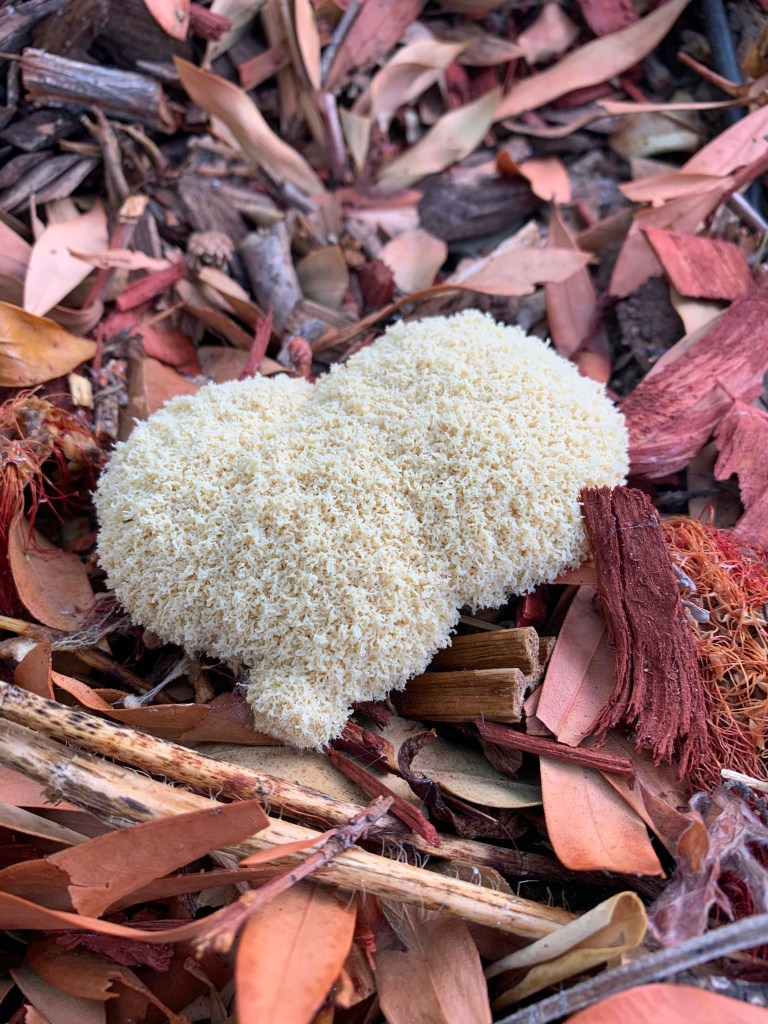
No, it is not one of our new recipes! Looking around the garden just a bit after 7 am in the morning, there was this white blob sitting on the mulch under the fig tree. First thought is maybe it is an unusual type of mushroom. However the surface texture is quite strange. Now some fungi can be really unique, so this needed some investigation.
A search turned up an image of Brefeldia maxima, a plasmodial slime mold, often called “tapioca” slime mold, that looked like our specimen. They get their “tapioca” name because they vaguely resemble a blob of white tapioca pudding. Our garden specimen is about 4 inches wide and 1 inch tall (10 cm by 2 cm). Amazingly it is a one celled organism! That one large cell. It has many nuclei, but still just one cell. One specimen in Wales covered about a square meter and weighed in at 20 kg! That is one huge cell.
What are slime molds?
What is a slime mold and what do they do? Turns out they are quite fascinating creatures. Not plants, not animals, not fungi, they are classified as “Protists”, which includes things like the amoeba and other single celled organisms. Despite being single celled organisms, the slime molds are amazingly complex and have fascinating behaviors and life cycles.
Some types of slime molds show significant social behaviors. Other slime molds can solve complex tasks such computing the optimum routing structure for the Tokyo transit system.
Rather amazing for a single brainless cell. It was fascinating to learn about these creatures and their unusual characteristics. We will share our discoveries with you in this article.
Cellular slime molds
The cellular slime molds, also known as dictyostelid slime molds, belong to the group Dictyostelia. Cellular slime molds exist as individual amoeboid cells for most of their life cycle. These are microscopic in size. When food sources become scarce, these individual cells send out signals to nearby slime molds. The cells then aggregate and form a multicellular slug-like structure called a pseudoplasmodium that consists of thousands of individual organisms. The pseudoplasmodium then moves as a unit, looking something like a slug moving across the ground. It seeks a suitable location to form a fruiting body. The fruiting body consists of a stalk and a spore-bearing structure at the top, which eventually releases spores for dispersal.
The fascinating behavior of these cellular slime molds is these independent cells come together as a social unit and then act as one organism. When they form their fruiting structure, the individual cells at the base start stacking on top of each other to form a tall stalk. Then those organisms at the very top turn into spores that will be dispersed to start new individual amoeboid cells.
What really interests evolutionary biologists is those organisms at the bottom of the stalk essentially sacrifice themselves to lift their cohorts up so their friends can create the next generation. This self-sacrificing behavior is rather unique, especially in a single celled, brainless creature.
Plasmodial slime molds
Plasmodial slime molds are the most common and well-known type of slime mold. They can be often found on damp forest floors, growing on leaves or tree trunks. They belong to the class Myxomycetes and are characterized by their large, multinucleated plasmodium, which is a single cell containing multiple nuclei. The plasmodium moves and feeds by engulfing bacteria, fungi, and decaying organic matter.
Their movement is through a process called cytoplasmic streaming, where the cytoplasm, or fluid of the cell, moves from one part of the cell to another. In the plasmodial slime molds, some of the cytoplasm has a gel texture and some is more fluid. The more firm parts form tube like structures through which the fluid cytoplasm can flow. Somewhat like small blood vessels.
In their movement, they seek out good sources of food, like one of us driving around looking for a good restaurant. When these plasmodia find a great place to eat, they let the rest of the cell know. Do they use “cell” phones? Then the rest of the cell moves that direction. Here is a video about their “intelligent” behavior.
When conditions are unfavorable, the plasmodium transforms into reproductive structures called sporangia, which release spores into the environment. Plasmodial slime molds typically can have brightly colored fruiting bodies that emerge during the reproductive phase.
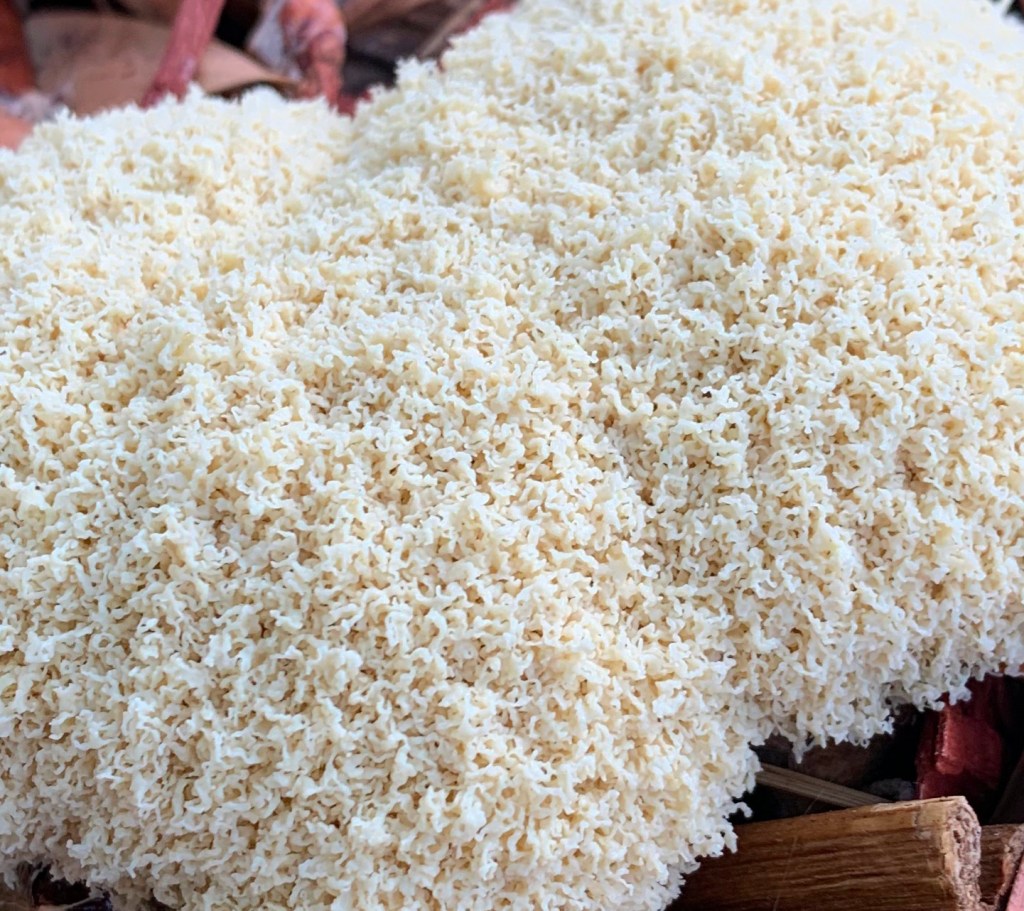
Our garden specimen is just moving into this stage preparing to form sporangia. Here is a closer view. You can see the very intricate structure on the surface with lots of little branches and bumps that will later form the sporangia.
The spores that form can survive hot dry conditions for many years, allowing the survival of these interesting creatures. When the spores have a moist environment with good conditions for growth, the spores open and release a small ameba-like cell. These cells are called myxoflagellate cells and have 2 flagellae (long hair-like structures).
It appears they have the extraordinary ability to use their flagellae to sweep bacteria next to them and then they engulf them. Very incredible feeding behavior for a single celled organism.
Potential benefits from slime molds
Another interesting plasmodial slime mold, Fuligo septica, also called scrambled egg slime, or dog vomit slime mold (a slimy yellow mass) has the ability to survive in environments with extremely high concentrations of metals, such as zinc. They have a special pigment that can chelate the metals and thus prevent them from causing harm. Extracts from Fuligo septica have been found to have some antibiotic and anticancer properties.
The plasmodial slime mold Physarum polycephalum has some antiviral capability. Their innate immunity to some viruses has been shown to benefit crops. Physarum polycephalum can protect against tobacco mosaic virus in tobacco and beans.
With the many species of slime molds, there may be some valuable benefits we will discover with more study of these amazing creatures.
Plasmodial life cycles
The plasmodial slime mold Physarum polycephalum appears to be one of the more studied species. In this species, and possibly others, their lifecycle is amazingly flexible and complex as they can go back and forth between different forms.
A spore will hatch into an amoeba. In very wet conditions they develop flagellae and swim. If just moist they remain amoebae that move by cytoplasmic streaming. When it gets dry, they form cysts that can survive long dry spells, the revive when moisture returns. They can also form sporangia and make more spores.
An amoeba can live indefinitely, by just dividing into two and reproducing by continuing to divide and divide, much as bacteria and many other single celled organisms. However, they can also mate with another amoeba, if they find another with an “appropriate” genetic background. No male and female, but there are genetic variations that may or may not be compatible.
Once the mating pair fuse together, they form one cell that does not divide. The cell nuclei do divide and the cell grows in size, crawling across whatever it is growing on to find tasty bacteria and other microscopic nutrients. These are the plasmodia we can see, some getting as large as a meter across.
The plasmodia will react to changing environment, like drying out, by two different reactions. In the dark, the will form a dry “sclerotium” that can withstand dry conditions, then when it is again wet, they rehydrate and come back to life. If dry and there is light, they form sporangia to produce lots of little spores and the parent plasmodium will fade away.
Slime mold biology
For those interested in all the wonders of our natural world, you’ll want to learn more about these slime molds. Here is another video about the crazy biology of the slime molds.
Brefeldia maxima – tapioca slime mold
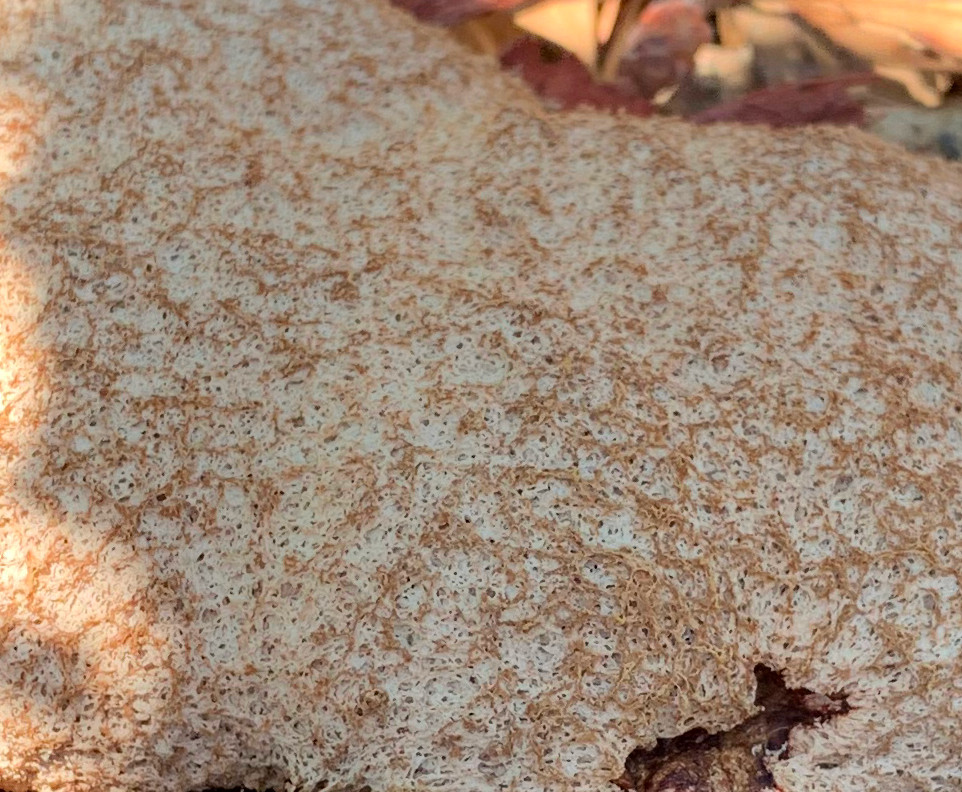
The first discovery of our garden slime mold was just after 7 am. The photo here was taken about 6 hours later, after 1 pm. The weather has been hot and dry, temperature close to 100 Fahrenheit (nearly 40 C) with humidity below 20%. Tough conditions for slime molds. We’ll watch it and see if it has time to produce sporangia before it dries up. Looks like it is getting toasted in this photo.
For a great detailed microbiologists view of tapioca slime mold, we found this video showing the life of one of these slime molds over a few months.
Hope you’ve enjoyed the tour through nature’s fascinating and often little known mysteries. Quite nice to run across these gems in our garden.
The Blob
It may have been someone learning about these plasmodial slime molds crawling across the forest floor or over plants swallowing bacteria along the way that came up with the inspiration for the science fiction horror movie “The Blob”.
 Zanganeh Garden
One response to “Tapioca Slime Mold”
Very interesting information
LikeLike