

June has generally been cool and grey. We call it our June gloom that follows the May grey. This time of year it is common to have a marine layer creep over the mountains to keep mornings overcast usually clearing late morning. This June we’ve had quite a few days staying cool and grey into the afternoon. The last day of June we did get into the high 90’s, so summer is here.
The cooler weather has been great for peas and lettuce, but slowed down warm weather crops like tomatoes and peppers. No complaining from us here, as we are certain to get plenty toasty soon enough.
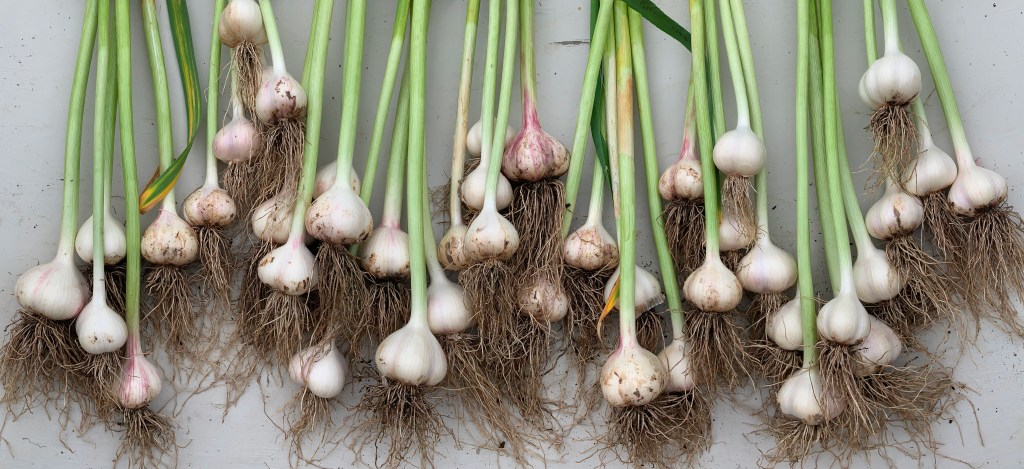
Garlic harvesting and curing has been on the top of our activities this month. We will be finished drying and curing soon, then we’ll get all the garlic sorted, weighed in and will be posting a full report of our garlic growing experience, yields and thoughts on the 8 varieties we grew.
Wild flowers are changing from spring varieties like lupines and poppies to the summer coreopsis and cosmos. Not as prolific, but still looking nice.
The fragrant flower of the month is gardenia, coming into full bloom with their heavy perfume. Can’t miss them when walking past. In second place for fragrance is the very tasty aroma of chocolate flowers!
We had a couple very notable visitors this month ranging from the elegant (red-shouldered hawk) to the sub-slime (tapioca slime mold). Interesting stories about both in the Visitor Log section.
Contents of this Post
Here’s a summary of what’s in this post along with quick access links.
- Harvesting Now – What we’re eating now
- Flowers and Herbs
- Coming Soon – Summer crops are nearly ready
- Visitor Log
Harvesting Now
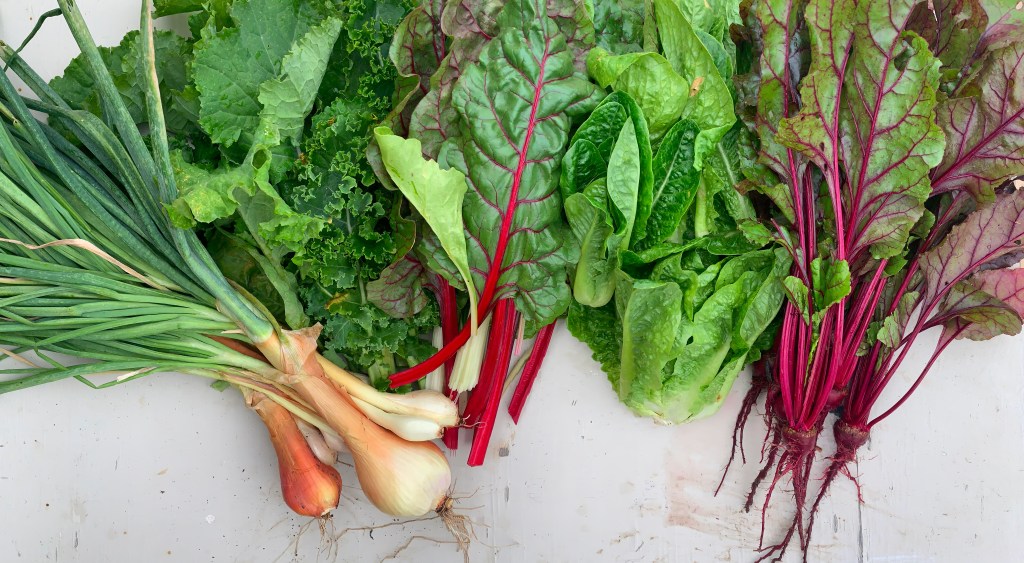
Sugar snaps produced well this season going into mid-June. Lettuce is in full production. Our lettuce of first choice these days is the Monte Carlo variety. They are a dark green mini-romaine style. Very crispy full heads that we find grow well and continue developing even as weather warms up.
Some of our kale bolted (started flowering) earlier than usual. Other kale are still producing well and we have a few new plants started to replace those quick to bolt. We suspect the cooler weather may have confused the kale causing them to bolt early. Beets are filling out. Our current batch are the Bull’s blood variety, a dark red beet with nice dark red/green leaves. We use the leaves along with their next of kin, chard, for many tasty dishes. Did you know chard and beets are the same species? They’ve just been bred to select better growth of tops or root.
We’ve been harvesting shallots as if they were spring onions, still on the green side. Some are large and look like regular onions. Harvesting them fresh we find the flavor is sweeter and more mellow. They will be ready for full harvest soon.
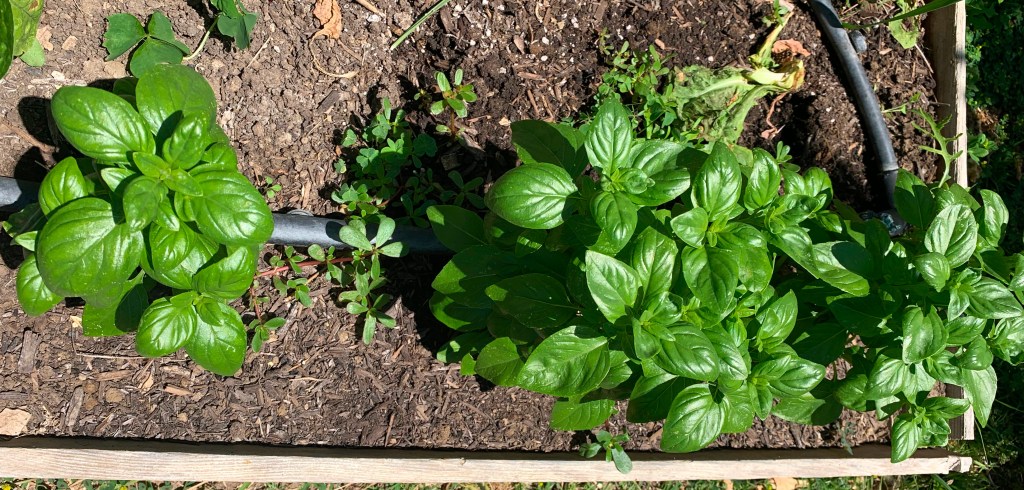
Basil harvest has started, a sure sign summer is arriving. We are growing more of the Emerald Tower basil we tried last year. It is similar to a Genovese style basil with nice dark green leaves in a compact growth habit that produces well and is slow to bolt.
Flowers and Herbs
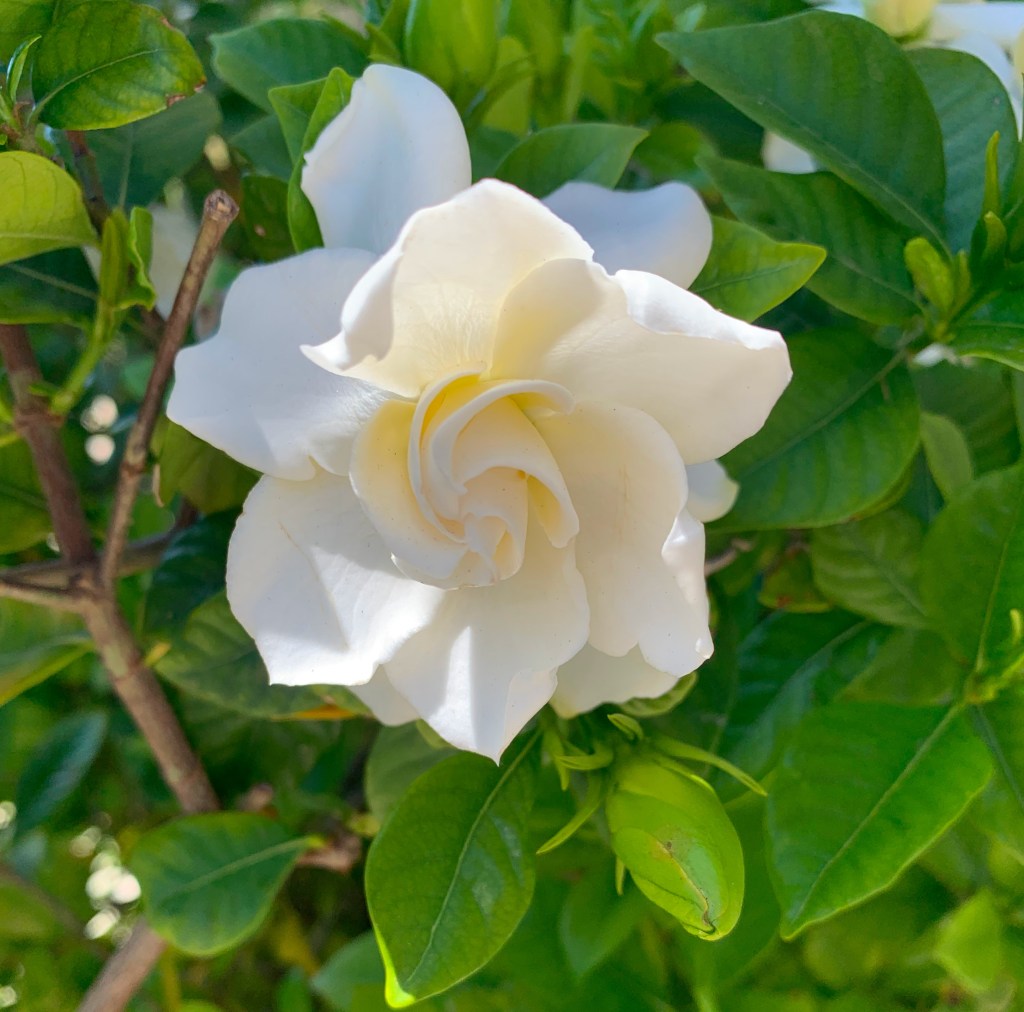
Fragrant flowers – gardenia and chocolate
The heavy scent of gardenia is the fragrance of the month. The bush is filled with creamy white flowers with their strong sweet perfume. We have one bush growing near our front porch where it gets shade in the afternoon, keeping it from getting too hot. It seems to like the location and we notice it every time we walk out the front door.
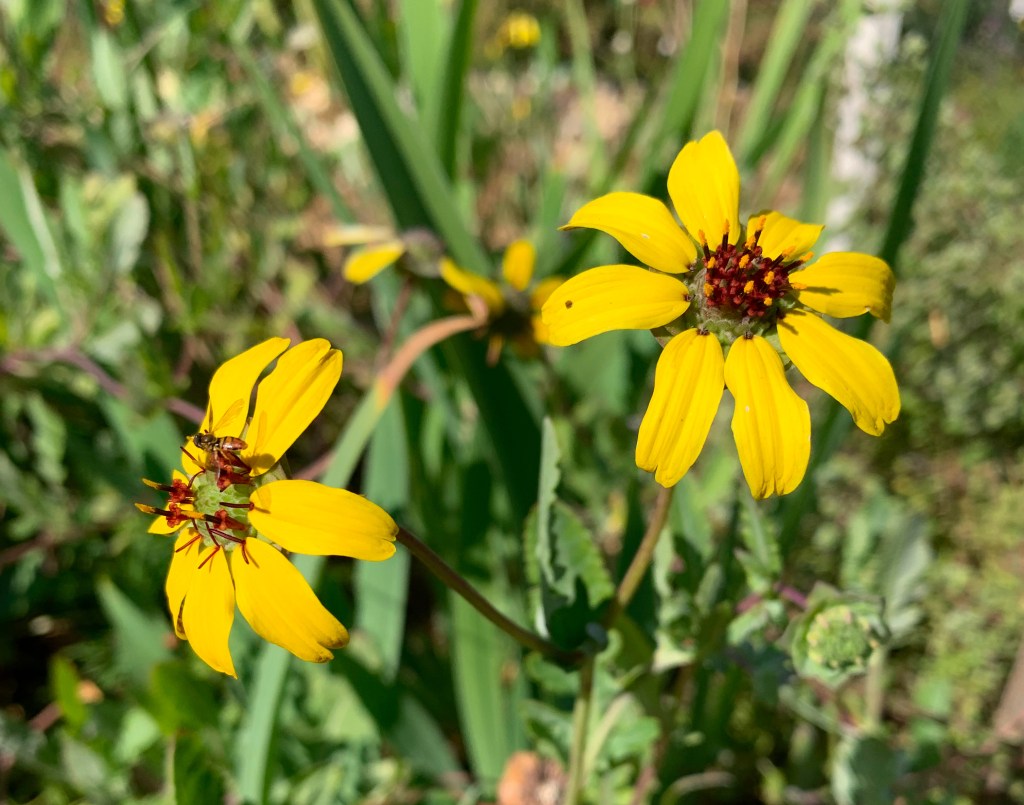
A different fragrance comes from the chocolate flowers. They are an interesting member of the composite family (along with sunflowers, daisies, zinnias and many others). They get their name from smelling a bit like chocolate! We planted some last year and just had a few flowers. This year they are producing lots of flowers.
Their botanical name is Berlandiera lyrata and are also known as lyreleaf greeneyes since the leaves are shaped like a lyre and after the flowers fade the seed head looks a bit like a green eye. They are native to the Southwestern US (Colorado, Texas, New Mexico, Arizona) and tolerate dry rocky soil, making them a nice low water addition to the herb and flower garden with a surprising fragrance. If you are looking for something a bit different, give them a try! They are rated for USDA hardiness zones 4-9, so should grow in many locations.
Drought tolerant landscape
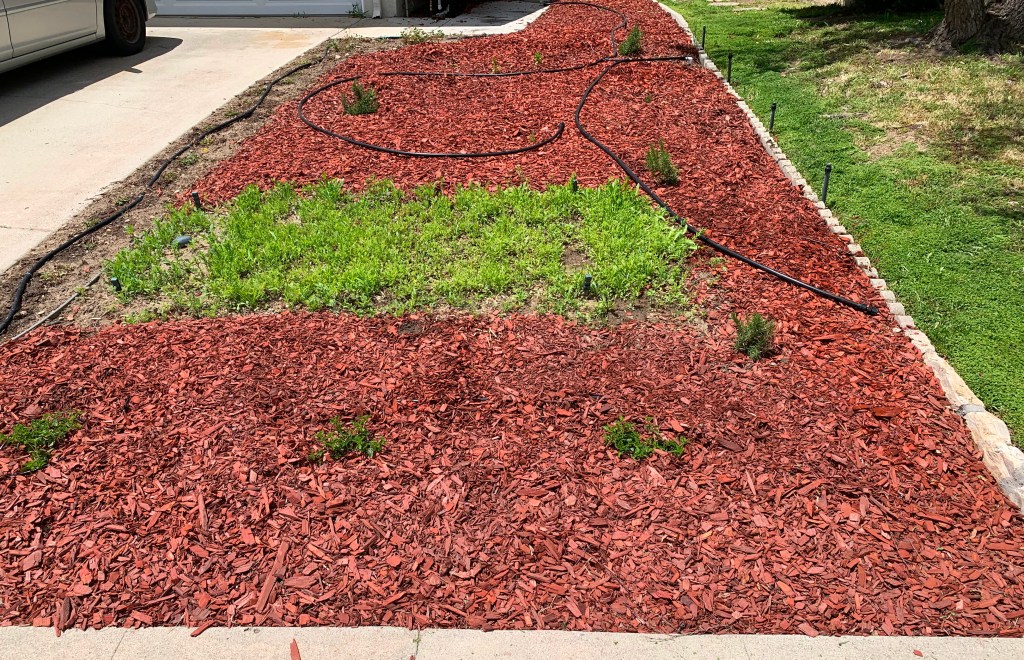
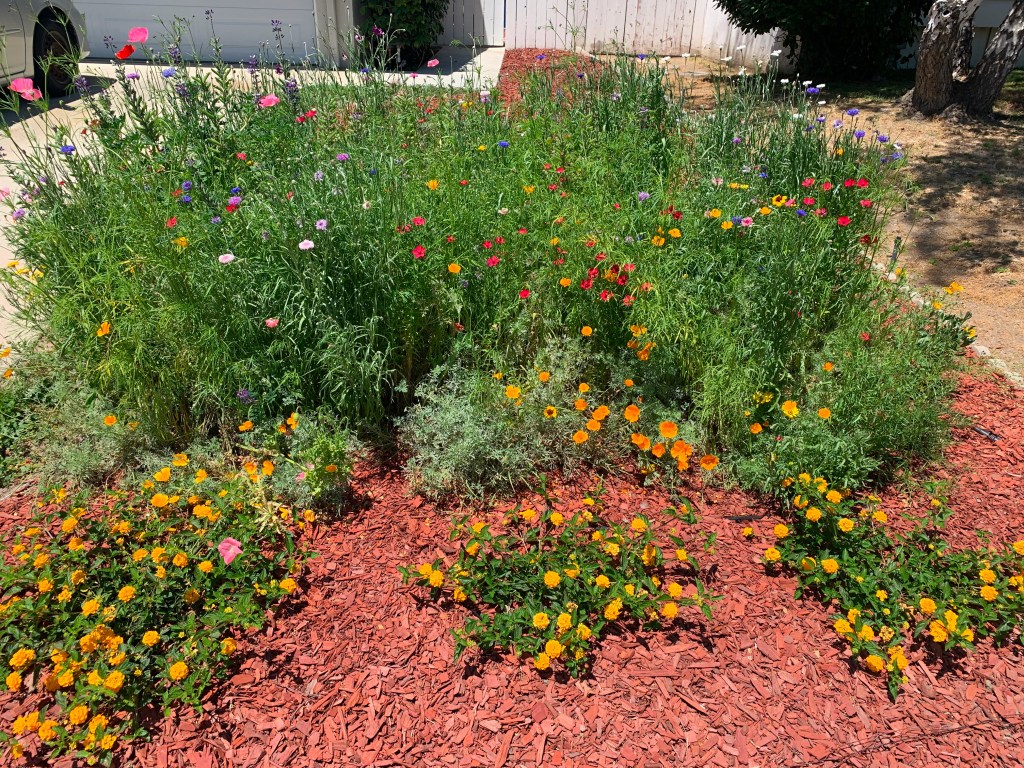
Our drought tolerant landscaping is filling in well. Plants took advantage of the cool weather in June to get established. With a drip system installed to give them slow deep watering and 3″ of mulch, they will be sending roots down to get through the hot weather that will be here soon. See the comparison photos below, the first taken on May 6, the second on June 30.
The wildflowers are really taking off. The desert bluebells we pictured in our May Update were one of the earliest flowers, blooming before end of May. The bright yellow lantana have filled out significantly. They are low growing and should spread well this summer. By late June the lupine were nearing the end of their blooming, but the California poppies are going strong, along with lots of red flax, Shirley poppies, bachelor’s buttons, and South African daisies. The bright yellow and red coreopsis are just getting started, they like the warm weather.
Garden volunteers
Escarole is a crop that loves to volunteer. In the composite family, escarole is a distant relative of lettuce. Escarole is a variety of chicory along with radicchio, frisee and Belgian endive. They are something of a “weedy” plant with slightly bitter leaves. Endives can be grilled or roasted to reduce their bitterness, but also add nice flavor variation to a salad. They have persistent seeds that stay viable for years and produce relatively tough plants that don’t need as much care as lettuce.
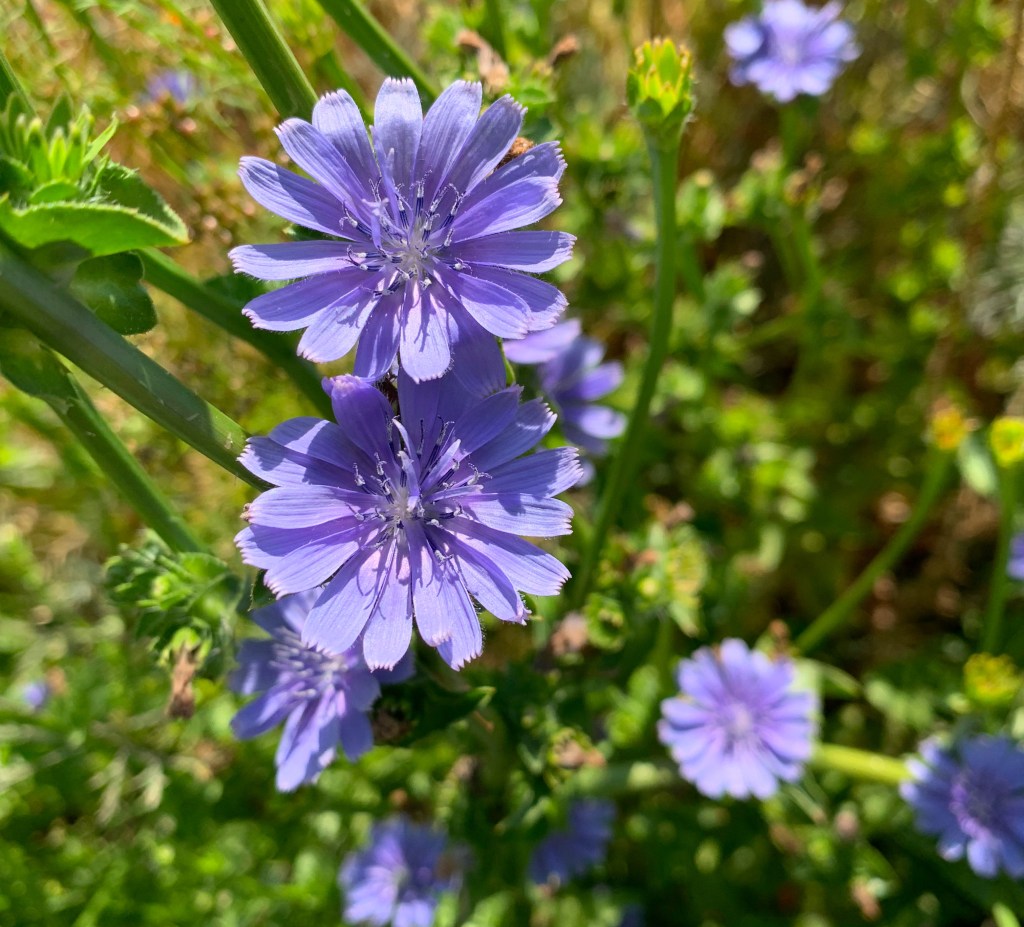
These attractive blue flowers have the characteristic look of chicory flowers. When the plants bolt and start to flower their stems get a bit rough and rangy looking.
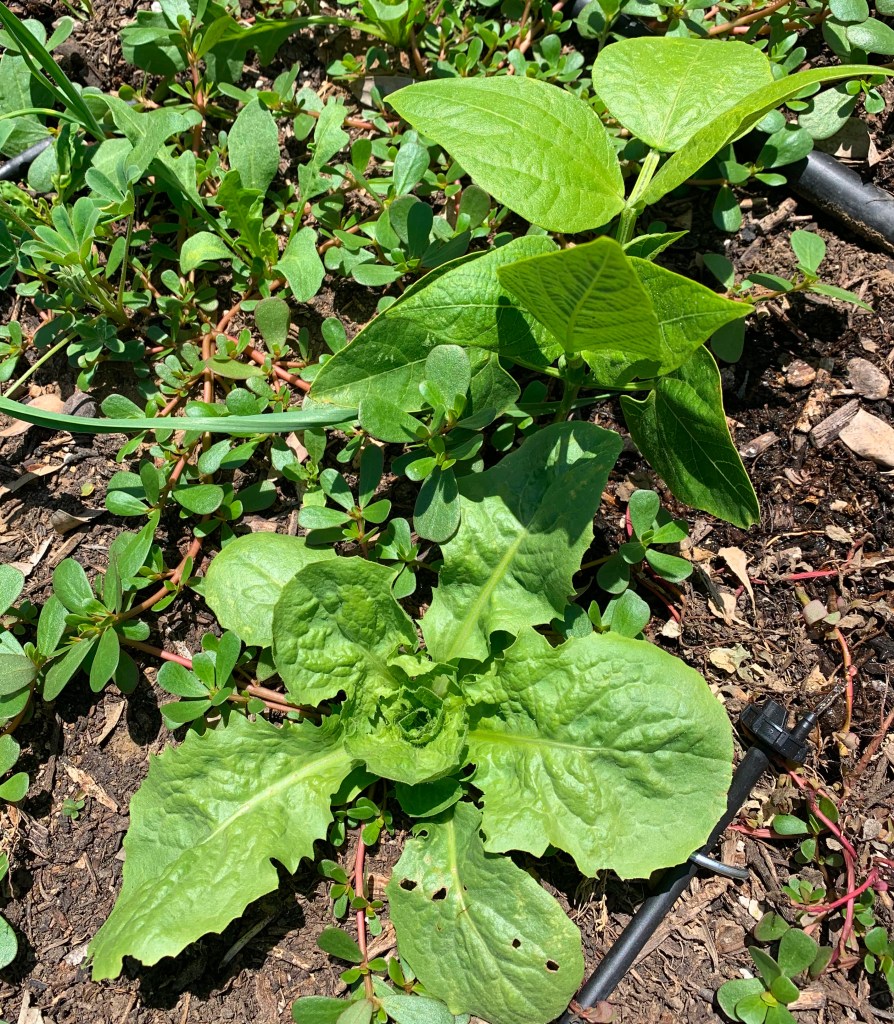
The first time we grew escarole, only a few came up and they didn’t appear to be a promising crop. We let one of the plants flower and produce seed. Some of those first seeds that did not germinate the first year were still viable, just taking their time to sprout. Now we have escarole popping up all over the garden without planting any seeds.
Other good volunteers for us in the photo above are purslane (also good in salads) and wild arugula. Purslane would probably take over the garden if we allowed it! Wild arugula has spread widely in the garden and with their deep roots they grow well in low water locations.
Feverfew

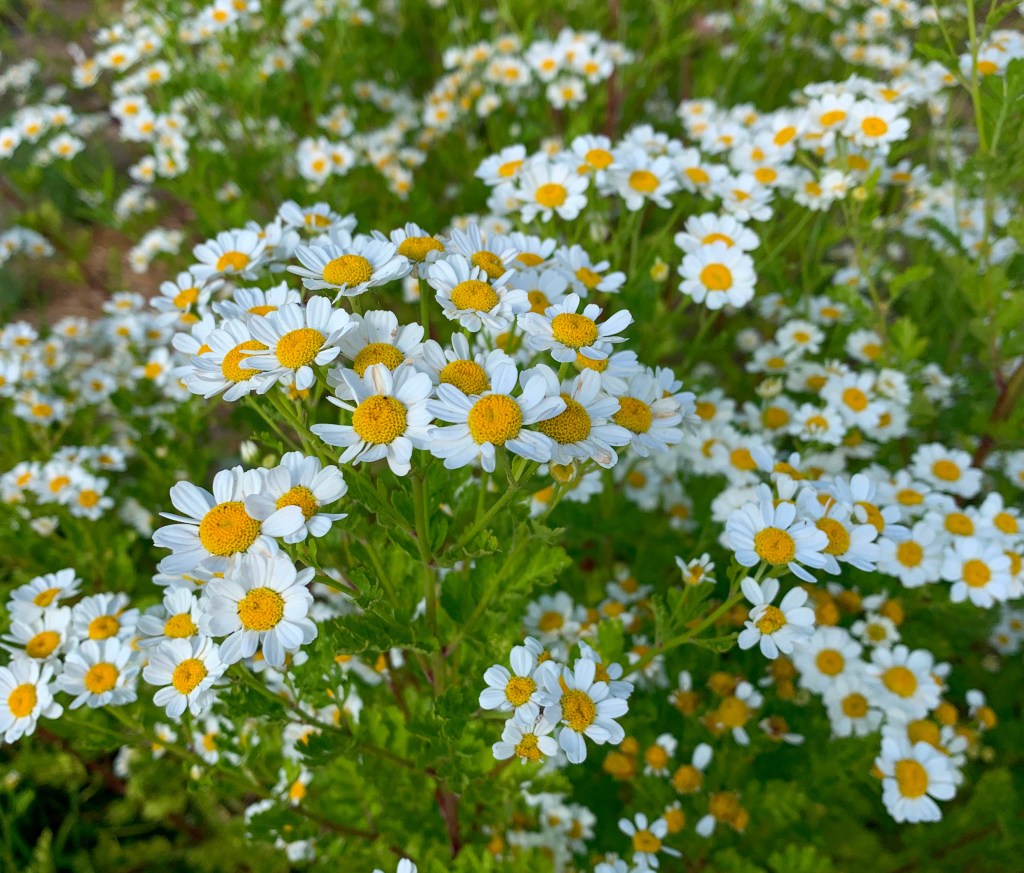
We planted feverfew seeds last year and by the end of the summer they were well established. This year they are really going strong, over 3 feet (1 meter) tall and filling out their space in the herb bed. Full of bright white and yellow flowers, a bit like their chamomile cousin, but with larger fuller flowers. The leaves can be used for tea that has a reputation of helping headaches, particularly the migrane type.
Mexican primrose
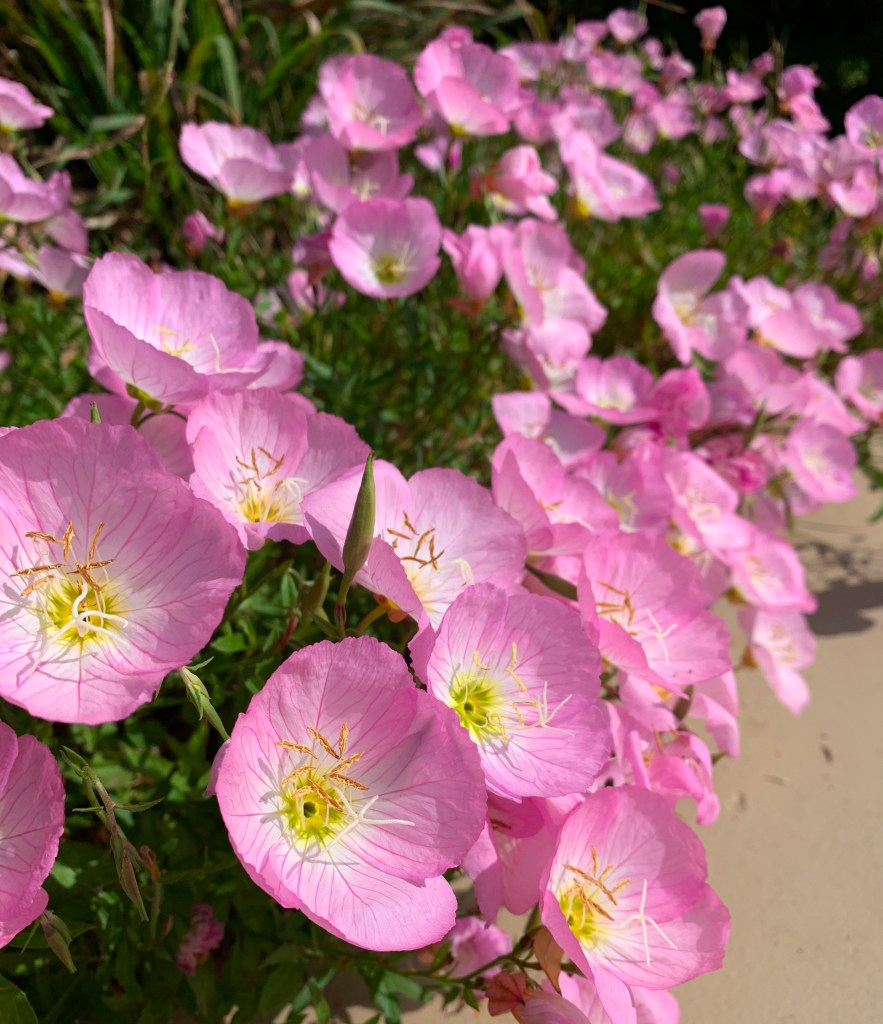
The Mexican primrose brings a lovely splash of pink to the garden. Their large showy flowers are colorful and the plants have a spreading growth habit that quickly covers the ground. They can start encroaching on their neighbors unless we keep them trimmed back. Not needing much water, they are a great addition to a low water landscape.
Coming Soon
We are still waiting for the larger summer vegetables to produce. The tomatoes do have some green fruit on them, but will be a few weeks before they will be ripe. Peppers and eggplants are getting flower buds, so maybe 3 or 4 weeks away from fruit. Squash is up and will grow quickly as weather gets warm. The first green beans are flowering, and will start harvesting very soon. Persian garden leeks (tareh) are almost ready to harvest. They are very similar to the usual large leeks, but with smaller leaves. Often used for eating fresh, similar to green onions, they are also used in cooking stews. We harvest the top of the leaves and they grow back from the base.
After harvesting garlic, those empty garlic beds will be replanted for later summer and fall crops. That will give us some nice late season production of beets, carrots, beans, lettuce and more. Most crops are 2 or 3 months from seed to harvest, so July planting will be ready for harvest September/October.
Visitor Log
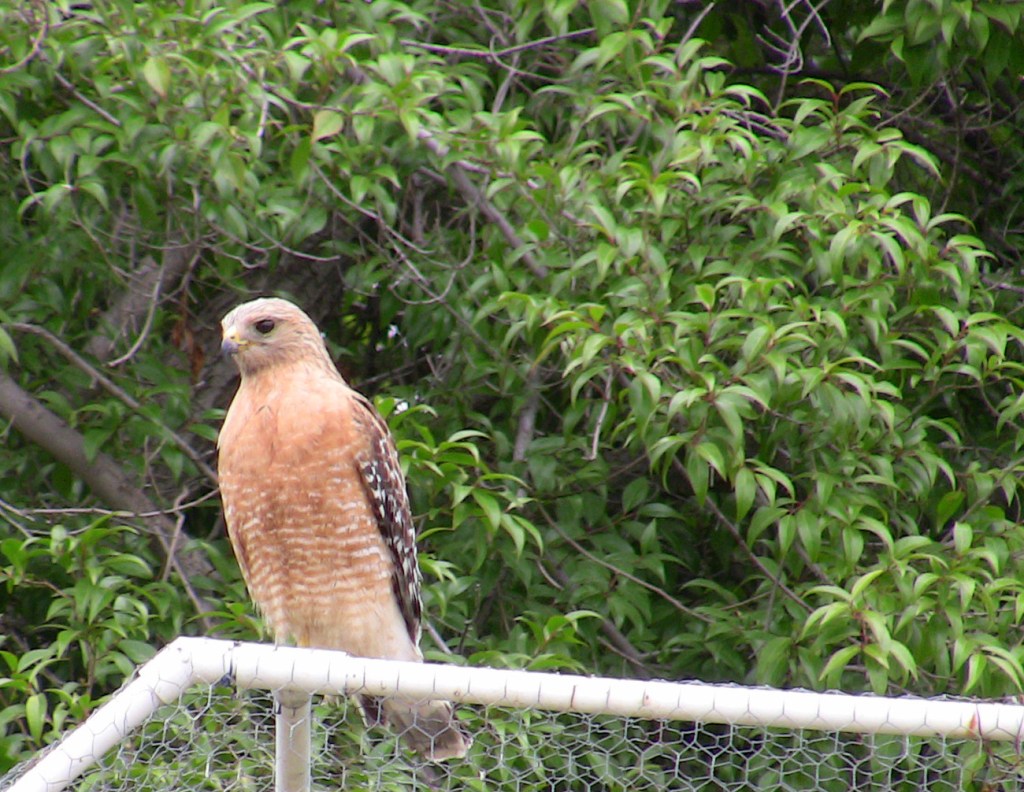
We have a breeding pair of red-shouldered hawks in our neighborhood. We hear their distinctive call frequently. The California variety is called “elegans” (like elegant). This variety has more vivid coloring and stronger markings than the Eastern US hawks. They make occasional visits to perch on our fig tree cage (designed to keep squirrels out). Lately we have seen a hawk perched on one of the stakes in the garden. We’re hoping to hire them to keep the squirrels away!
Here is a short video where we caught one of the hawks on camera.
The magician’s story
We have two fig trees with poultry fencing cages around them to keep squirrels from eating the figs before we do. Those cages have been effective in keeping those pesky critters out. One of the downsides is an occasional small bird, like a finch, will be feeding near the cage and slips through one of the holes in the cage then panics, trying to fly out. What they need to do is relax, sit on the fencing, stick their head out and just pop back out. However, they don’t seem to figure it out!
Other birds, like the Bewick’s wren, bounce in and out of these cages quite effortlessly. The wrens spend more time jumping than they do flying, so with their wings closed they easily glide through the holes in the fencing.
One recent morning we saw a goldfinch inside the fig cage, trapped by its own actions. Our usual response is to open the cage door and the birds eventually find their way to the exit.
On this day, after opening the cage door and walking to the back of the cage (to encourage the goldfinch to head toward the exit) events took a different turn. There was a whooshing sound and a flash of something quickly passing the cage.
It took a second, or probably a fraction of a second, to interpret what happened. The object passing the cage was one of our hawks. Glancing at the cage revealed the goldfinch was no longer there! Its last known location was still a few feet from the exit. A quick turn to look in the direction of the hawk revealed a small bird in the talons of the hawk!
Now all this transpired in just the blink of an eye. There was no struggle. The hawk appeared to just fly past the cage, not even pausing for a moment. The capture of the goldfinch was a magician’s slight-of-hand. The magician says, “Keep your eye on the bird.” Then the magician makes the bird disappear without a trace. Indeed, the hawk is quicker than the eye.
How it got the goldfinch out of the cage remains a mystery. Did the goldfinch just pop its head through a hole at just the wrong moment? Did the hawk somehow get a toe through one of the holes and snag the goldfinch through the cage? Did the goldfinch get a glimpse of the hawk and flew unwittingly to the door where the lucky hawk arrived just in time to grab the goldfinch? How did the hawk know to time its dive to the cage at just that right instant?
Whatever the details, in the blink of an eye, the hunter found its prey. Amazing events like this happen many times a day. We are not aware of the skill and agility of creatures like this red-shouldered hawk. Spend time closely observing nature in a garden and we come away enlightened by the amazing events that transpire.
A microbial visitor gets BIG
Another quite surprising visitor to the garden in June. An unusual white blob with a very strange surface texture showed up in the mulch under one of our fig trees. Could it be a weird fungus of some sort? An online search found a match with Brefeldia maxima, aka “tapioca slime mold”. Ok, now what is that?
First, slime molds are not commonly known organisms. Those taking botany or microbiology have been exposed to them, but they probably go unrecognized by most people.
They are most often found in cool damp locations, such as the forests of the Pacific Northwest. Not something we expect to see here in our dry Southern California climate. We did have wet cooler weather this spring, so maybe this creature decided it was time to grow.
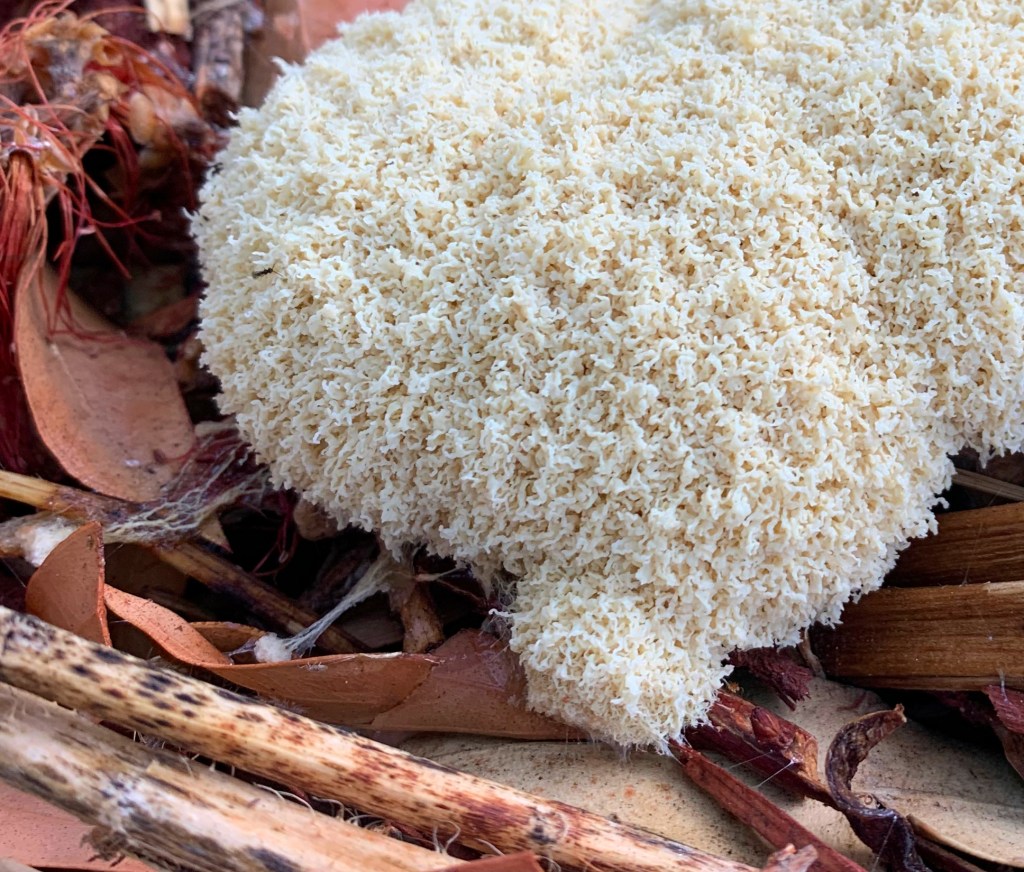
These organisms can live many years as little microscopic amoebae, swimming in water, or crawling across damp leaves or other materials. What we found was one that had grown much larger, about the size of the palm of a hand. Amazingly it is still just a single cell and it can “crawl” around! In the photo above there are strands of the plasmodium stretching to the lower left. Maybe where it is going next, or maybe where it came from.
After more investigation into these creatures, we learned many amazing bits of information about the unique lifecycle and behavior of slime molds. You can check out all the details on our post Tapioca Slime Mold.
For those familiar with old movies, someone was probably learning about these slime molds when they came up with the idea for the science fiction horror movie “The Blob”.
Squirrel munches on fava beans
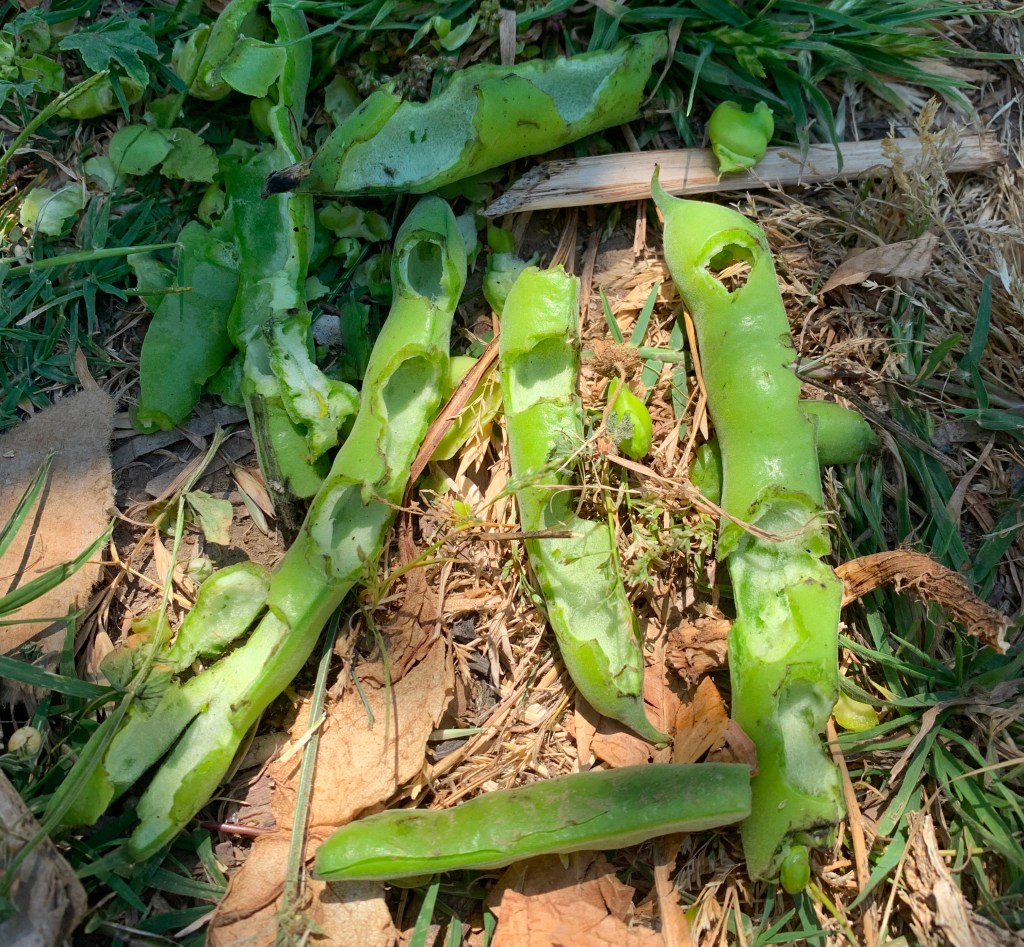
Our local squirrel is not an unusual visitor. In fact we see the same squirrel nearly every day. They’ve been seen eating greens like chard and lettuce, nibbling on the seed heads of calendula flowers, digging in newly planted garden soil to find a few worms, running off with mandarin oranges, devouring pomegranates, grabbing all the figs just before they get ripe, etc. Lately it has been munching on the last few fava beans in the garden. We have harvested most of the large ones, but a few smaller plants are left with some bean pods still on them. The squirrel apparently finds them as tasty as we do and they have sharp teeth that cut through the tough skins much better than our teeth. Here’s some remnants of the squirrel’s lunch. Notice how it knows exactly where to find those tasty tender beans and chews through the pods to get each bean.
Find Peace in a Garden
Find time to get out in a garden, a park or a spot where nature is on display. Keep an eye and ear out for that magician hawk. Look down and maybe you’ll find some slimy creature slowly creeping across the ground. Listen to the sounds, observe life, find peace.
If there are topics you would like to hear more about, let us know in the comments below, or send an email to Zanganeh.Garden@gmail.com.
We post quick updates on Instagram @Zanganeh.Garden
Check out our YouTube channel, also @Zanganeh.Garden
Use the subscribe button below to be notified of new posts.
 Zanganeh Garden