

July quickly turned into a hot summer month. The cool weather of June slowed the maturation of summer tomatoes, peppers and eggplants. They are now enjoying the warmer weather of July trying to make up for lost time. Tomatoes did not get ripe until the very end of July, a few weeks later than our usual expectation.
Garlic beds have been converted to green beans, lettuce, kale and squash for the summer season. The spring wild flowers have transitioned to summer cosmos, coreopsis, sunflowers, and black-eyed Susans (rudbeckia).
The garlic we harvested in June has dried and we have sorted, weighed and cleaned up the bulbs. A good harvest of over 50 pounds of garlic. Shallots were pulled and are now in the drying mode.
We have a many of our feathered friends visiting the garden this month. In our visitor log we share some of their latest hit songs as well as some videos of their antics.
Contents of this Post
Here’s a summary of what’s in this post along with quick access links.
- Harvesting Now – What we’re eating now
- Flowers and Herbs – Colorful sunny summer flowers are in bloom
- Coming Soon – Summer veggies on the way!
- Visitor Log
Harvesting Now
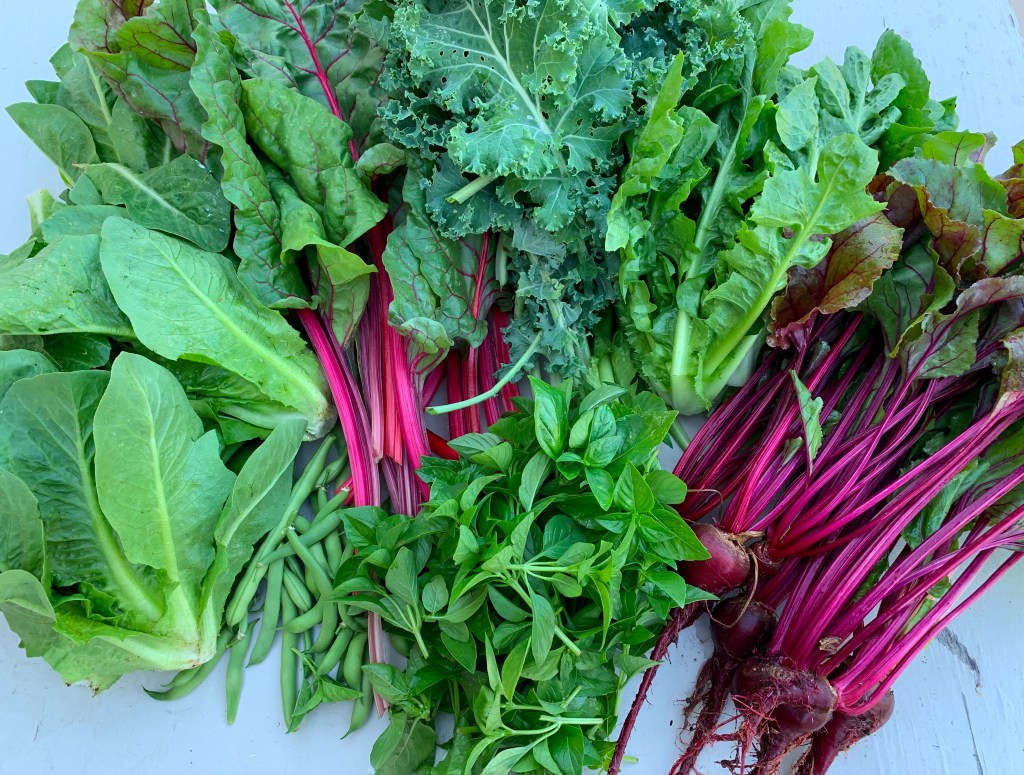
Garden production in July has still been good for greens (lettuce, kale, collards, chard, escarole). Beets are still in harvest mode as well. Our first green beans started producing nice tender beans.
Basil is getting into full swing and along with our good garlic harvest we were inspired to make some pesto. We made our own variation with a smooth creamy texture. Check out our recipe for creamy roasted garlic pesto.
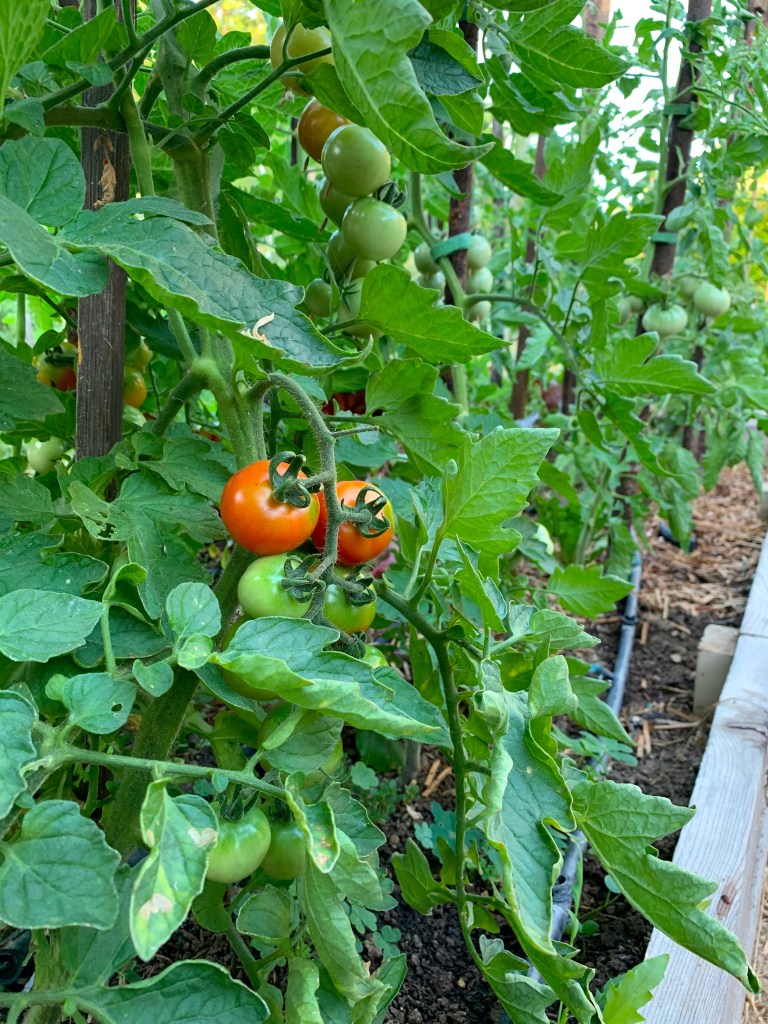
We finally picked the first tomatoes of the season on July 31. A bit late for our normal production with lots of green ones still a few weeks from harvest. The earliest variety for us was Gardener’s Delight, which is a reliable heavy producer of the smaller plum sized tomatoes.
Bell peppers are also just getting ripe. This year we are growing a standard green California Wonder variety as well as a purple variety. The purples get the award for the earliest production. The plants are still growing and have not reached full size yet, so we expect much more to come.
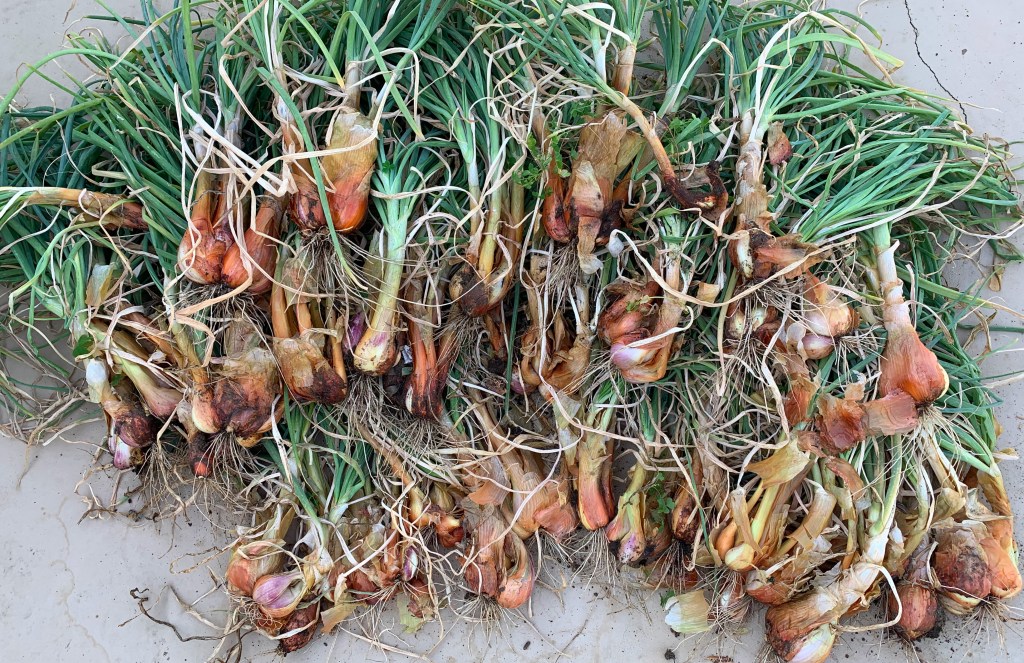
Shallots got pulled and are getting dried for storage. We got some nice large shallots from the bulbs we planted. The shallots we started from seed did not get as large as we would like. Part of the smaller growth was due to location. The seeds were planted on the north side of the bulbs, so as the bulbs grew quickly, they shaded the small young seedlings. In hindsight the seeds would have done better if they were south of the bulbs. Another gardening lesson learned!
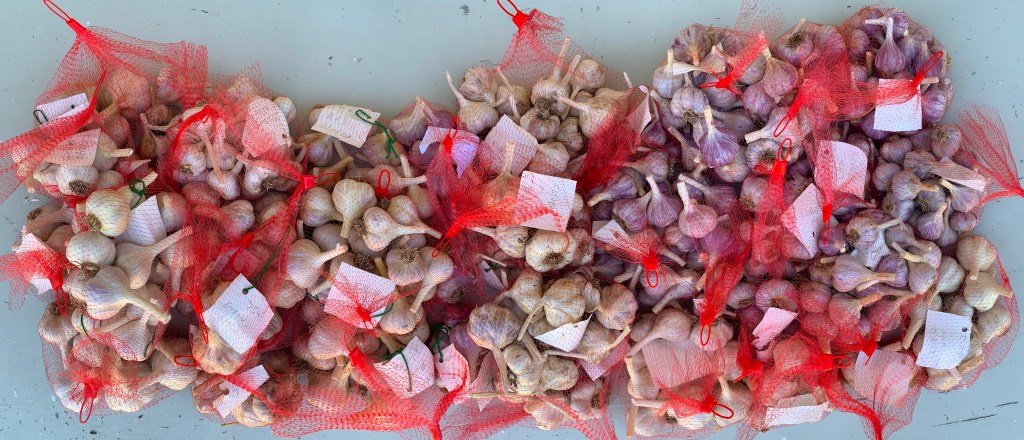
Garlic was harvested in June. It has been drying and we now have all the garlic cleaned up , trimmed, sized, weighed, and put in net bags for storage. We grew over 50 pounds of garlic, from 8 different varieties.
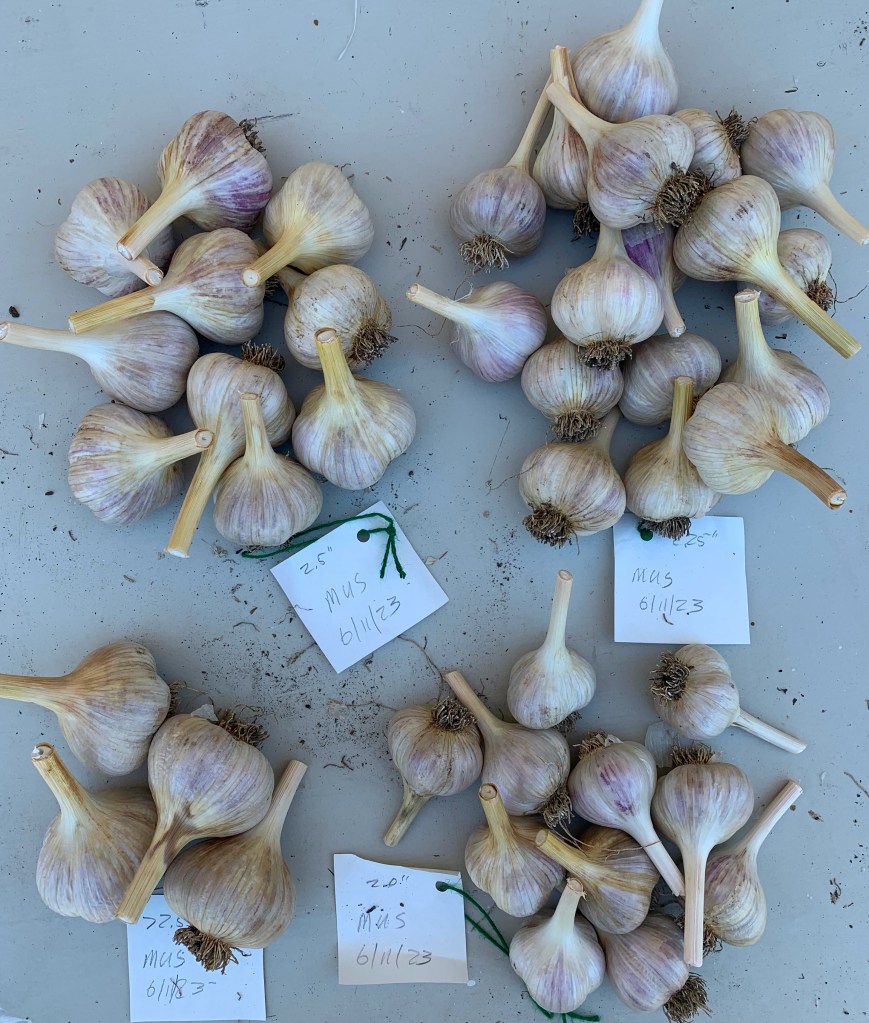
Music garlic is one of the “porcelain” type garlics we grew this year. The porcelains have 4-6 large cloves in each bulb. The bulbs are also larger than the other types of garlic we grew. The bulbs are smooth, plump and full. We planted 3 varieties of the porcelain type, Music, German Extra Hardy, and Romanian Red. All have a similar growth pattern with a smaller number of large cloves in each bulb.

Dunganski garlic is one of the “purple stripe” types of garlic. They have an attractive purple stripe as one might expect. The bulbs are smaller than the porcelains and they have 9-12 medium to small cloves per bulb. We grew 3 varieties of the purple stripes, Dunganski, Chesnok, and Persian Star.
We also grew 2 varieties of softneck garlic, of the “artichoke” type. These look more like the typical garlic we find in the market. A plain looking, medium sized garlic. We grew Inchelium Red and Early Italian varieties.
We plan to write another article focused on the details of our garlic growing experience to follow up on our previous garlic growing experiment post.
Flowers and Herbs
Sunny Flowers
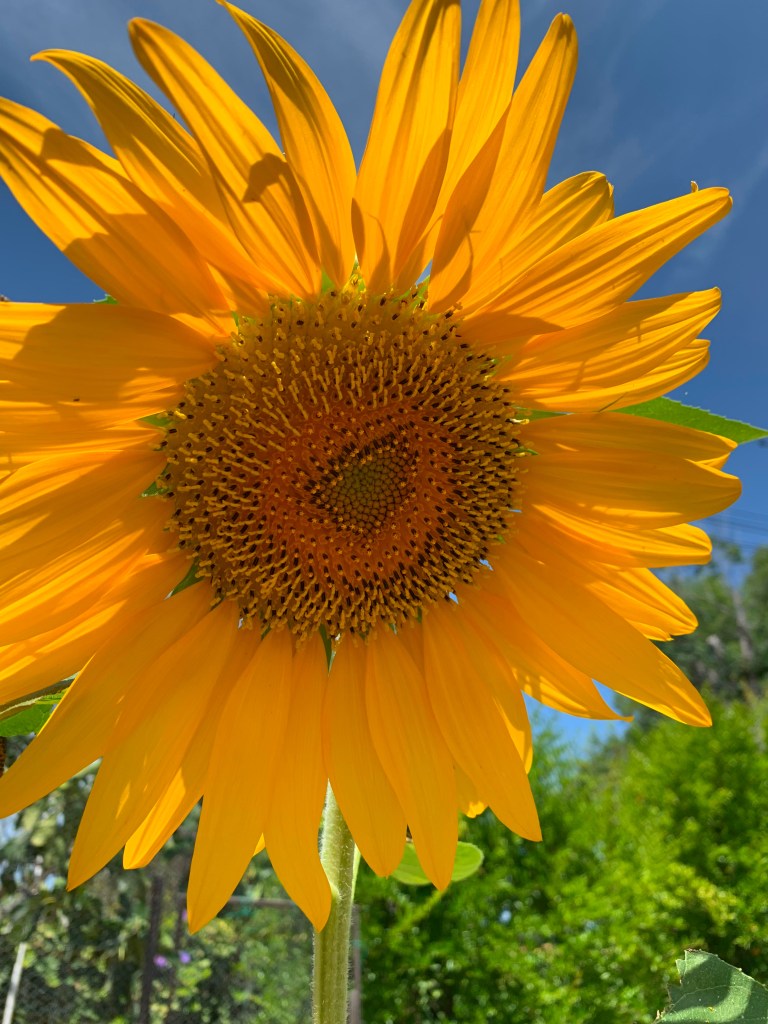
We have a few large sunflowers giving a sunny look to the garden. In the past we’ve had squirrels harvest the sunflower heads long before we considered them ripe. We will see if we can keep squirrels from eating them all before we can get some for ourselves.
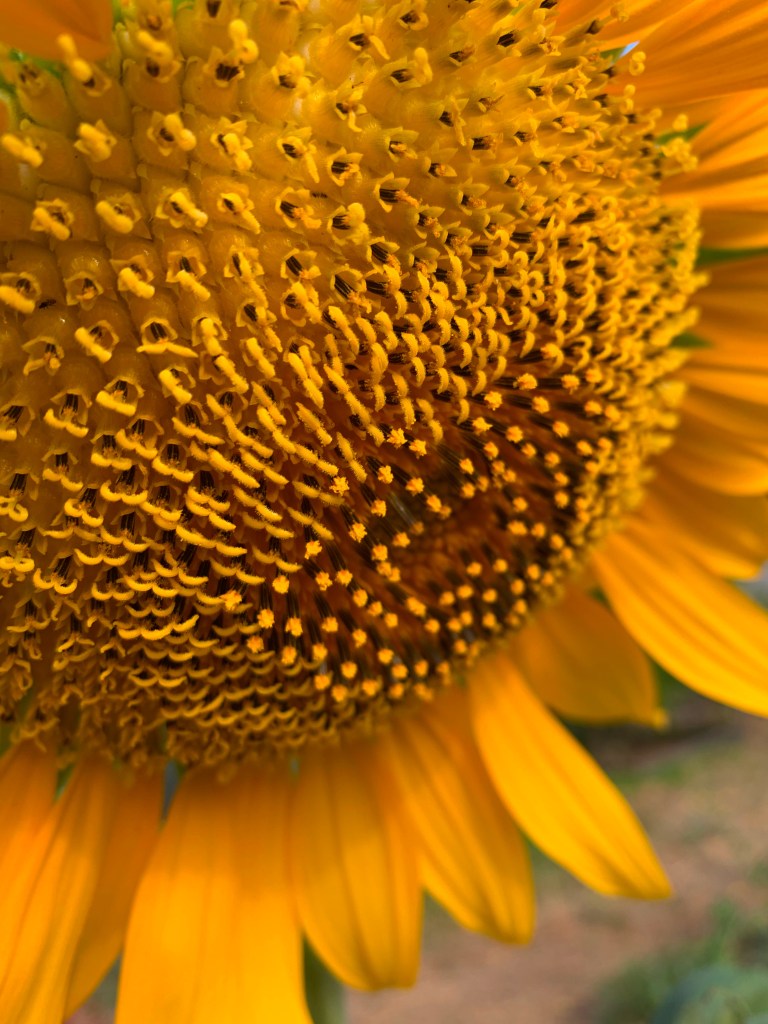
These large flowers are a great example of a composite flower where each of the sunflower seeds comes from a separate flower. Many members of this family have flower heads with two types of flowers. The outer flowers of a sunflower head have long yellow petals that stick out on one side of the flower. These are called the “ray” flowers. The flowers in the center of the head are smaller with 5 small petals. These are called the “disk” flowers.
The detailed photo above gives a nice view of the whole head of flowers showing the disk flowers toward the center with yellow pollen tipped anthers poking out. The flowers toward the outside of the head have their curled stigmas popping out, which is where the pollen will land to fertilize and produce the seed.
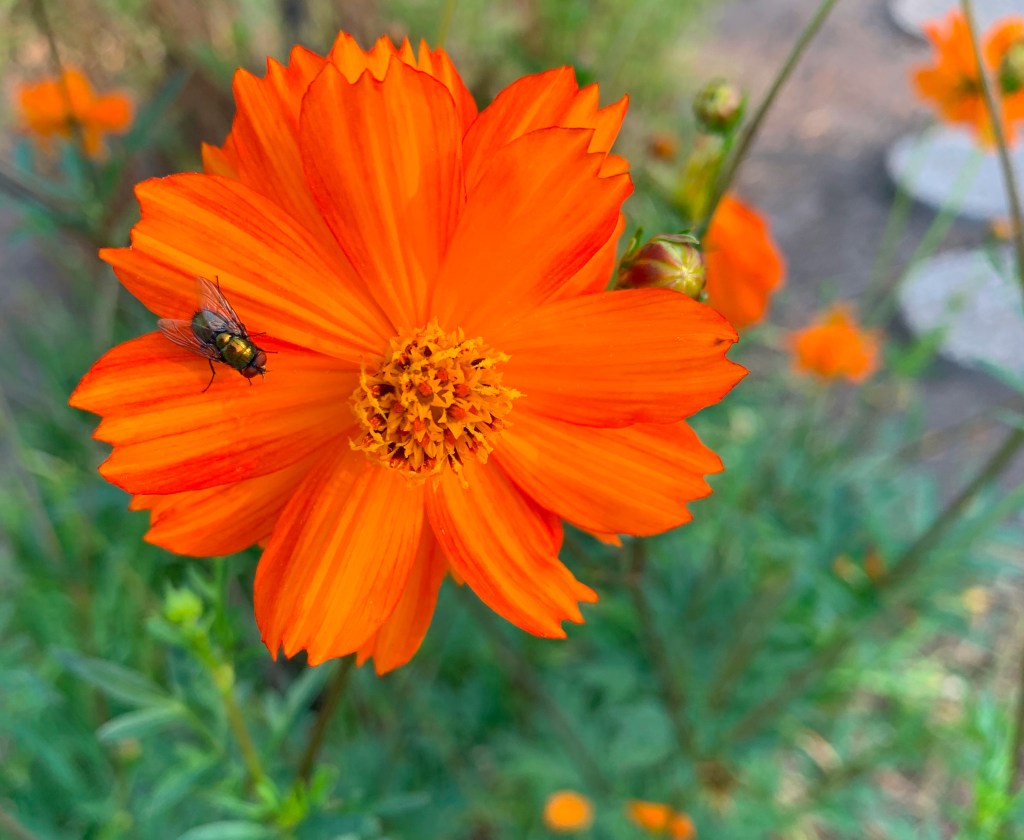
These orange cosmos are a cousin to the sunflowers. Looking closely at the center of the flower there are a number of individual flowers in a small head. Much smaller and with fewer flowers than a sunflower, but still bringing some sunny color to the garden.
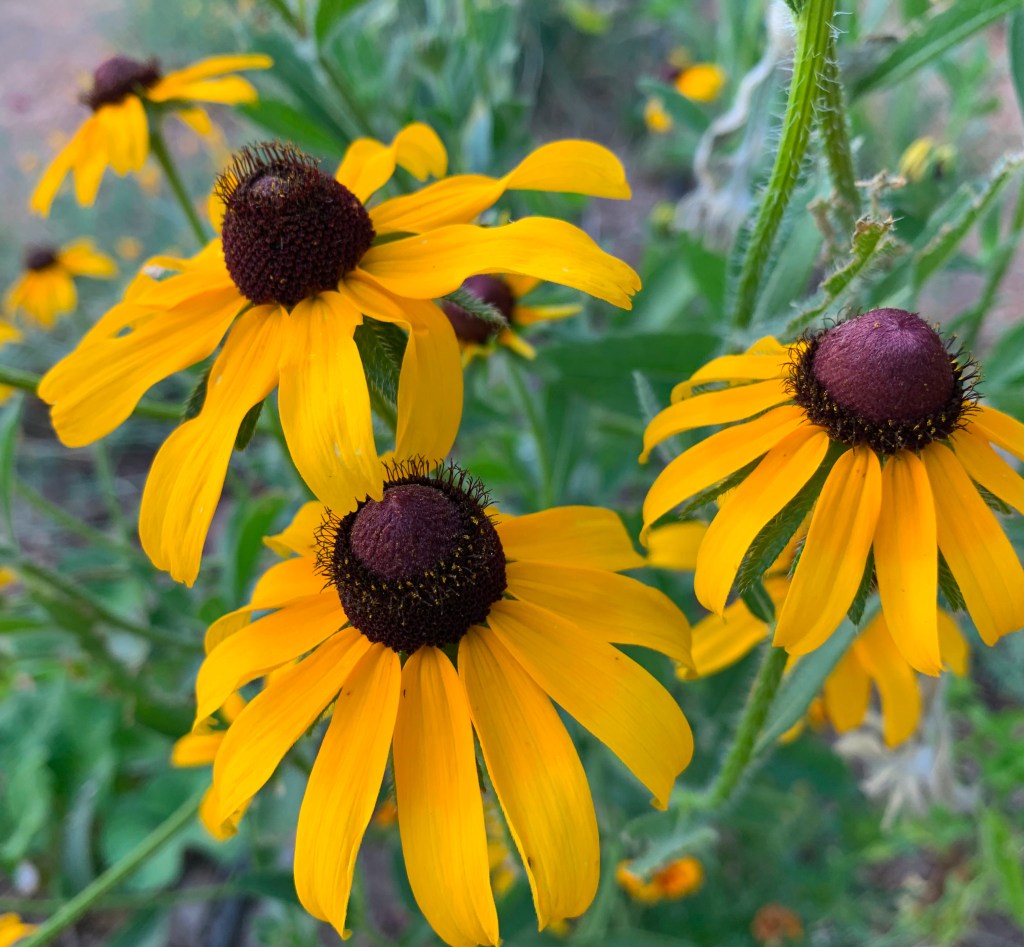
Yet another cousin of the sunflower, the Black-eyed Susan has lots of dark brown to black disk flowers in the center of the head. They still have those yellow-orange ray flowers on the outside of the head.
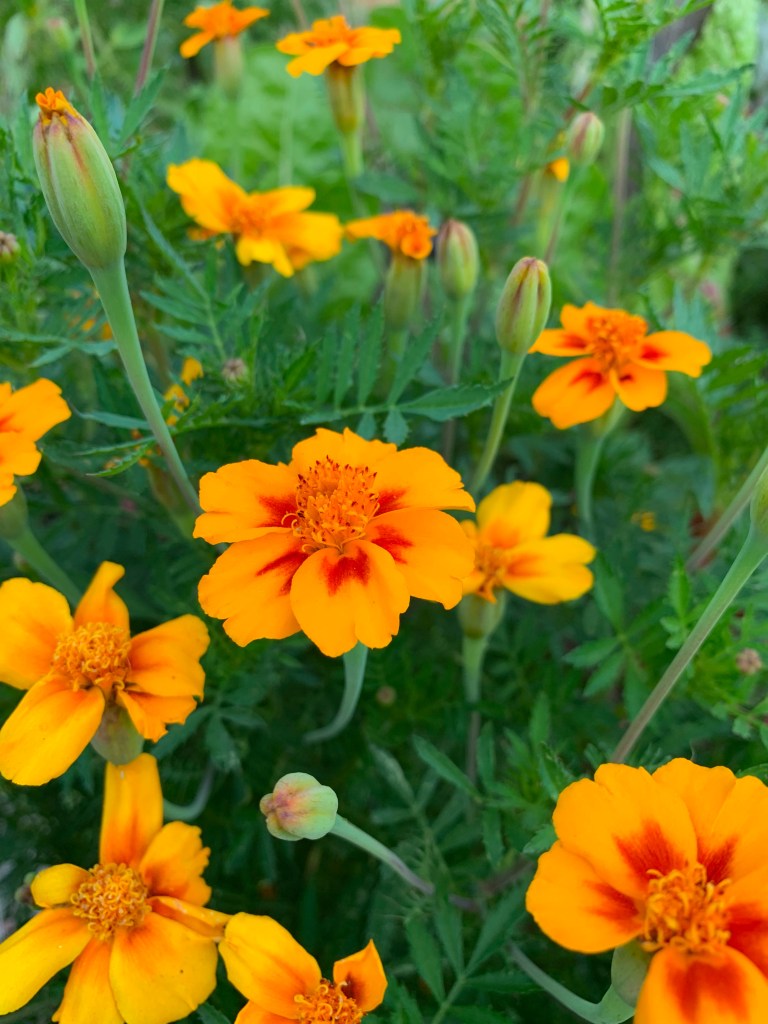
Another of those sunny yellow-orange composite flowers is the marigold. We plant a few here and there throughout our vegetable and herb beds for a couple reasons. They add a nice splash of color and they have some pest repellant properties. One of the pests they are reputed to help with is the root knot nematodes. Known as RKN (for Root Knot Nematode) they are a microscopic little round worm that invades the roots. They can cause serious damage to plants. We have seen signs of RKN and hopefully the marigolds keep them from becoming a problem.
Coming Soon
Tomatoes have just started getting ripe with many green fruits on the way. Most of ours are the indeterminate varieties, which can get tall and sprawling. We trim and pinch off the extra shoots every week. This year we are also growing some determinate tomatoes that are known for a heavier production of fruit all at one time. So far we haven’t seen a lot of fruit set on them. Hopefully the warmer weather will get them in gear.
Squash has started producing and we have a second round growing. We planted green beans in 3 sets. The first set is producing now and flowers are blooming on the second wave of beans. The third wave was planted later and we are hoping will give us a steady supply of green beans through the fall. Most of our beans are the bush style with one planting of the pole beans already climbing over 7 feet. Once they are all getting ripe we expect to enjoy those tasty beans frequently.
We also staggered the planting of lettuce with an attempt to keep them producing into September if we are lucky. The heat of July has caused some temporary wilting of tender young lettuce, but the established plants are holding on well.
Basil is another crop we planted in a second round to get more late season production. They will keep producing until we get frost, usually in December for us. So they have plenty of time to help with our pesto making!
Then we started some late season okra. In our experience they really shut down production when the weather cools off. Hoping they will get into production mode in this warm weather so they will have a couple good months to grow. Usually hot weather season goes into October. That should give them time to produce well.
Visitor Log
Bird Songs
As usual we have many types of birds visiting the garden. We enjoy listening to their variety of songs and calls. This month the Northern mockingbird has been singing his heart out for hours at a time. The house finches add their constant chattering. Then we get less common visitors like the very noisy wild parrots that sound like a gang of rowdy teenagers squawking away. Here’s an audio file for you to get an idea of our garden sounds.
Goldfinches
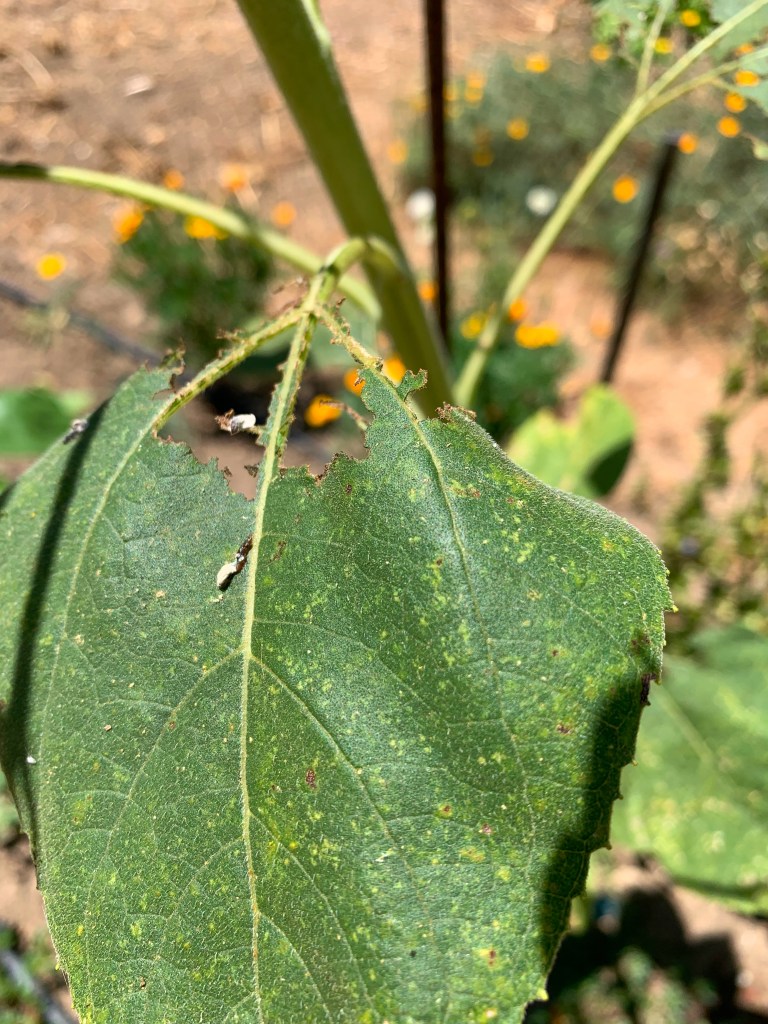
We noticed our sunflowers are having their leaves eaten down to the veins. Our first thought was maybe we had some hungry grasshoppers chowing down on the leaves. Then we captured these Lesser Goldfinch switching from the normal seed eating diet to the green leaves of the sunflowers! Guess they heard us talking about all the benefits of eating your greens.
Hooded Oriole
Recently we see an occasional flash of black and orange flying from tree to tree. The bright color indicates a male oriole is around. The female has a more subdued yellow to grey coloring. We had thought the orioles were Bullock’s orioles, but we caught this one in a rare mood sitting on a wire for more than a minute. It is clearly the Hooded oriole, with that solid orange head. The Bullock’s orioles have black on the top of their head and a stripe through the eye. Both types of orioles are in our area.
One interesting fact about the Hooded orioles is they make nests in palm trees, stitching their nests to the large plam leaves.
Cabbage White Butterfly
It is butterfly season. Flowers in the garden attract those fluttering butterflies. The most common one we see is the Cabbage White butterfly. As their name suggests, they hang around the cabbage and other cruciferous vegetables (like kale and collards). The young caterpillars can chomp away a surprising amount of leaves on our kale and collards, so we try to keep them from eating too many of them.
We caught these butterflies sampling the oregano and marigold flowers, as well as paying a visit to the collards. Maybe visiting their old homestead. In the video below you can watch the butterflies getting some sweet sips of nectar and see some of the leaves that have been chewed on by those little green youngsters.
Find Peace in a Garden
Find time to get out in a garden, a park or a spot where nature is on display. Listen to the sounds of those birds, observe the colors and amazing details in all flowers and plants, find peace.
If there are topics you would like to hear more about, let us know in the comments below, or send an email to Zanganeh.Garden@gmail.com.
We post quick updates on Instagram @Zanganeh.Garden
Check out our YouTube channel, also @Zanganeh.Garden
Use the subscribe button below to be notified of new posts.
 Zanganeh Garden