

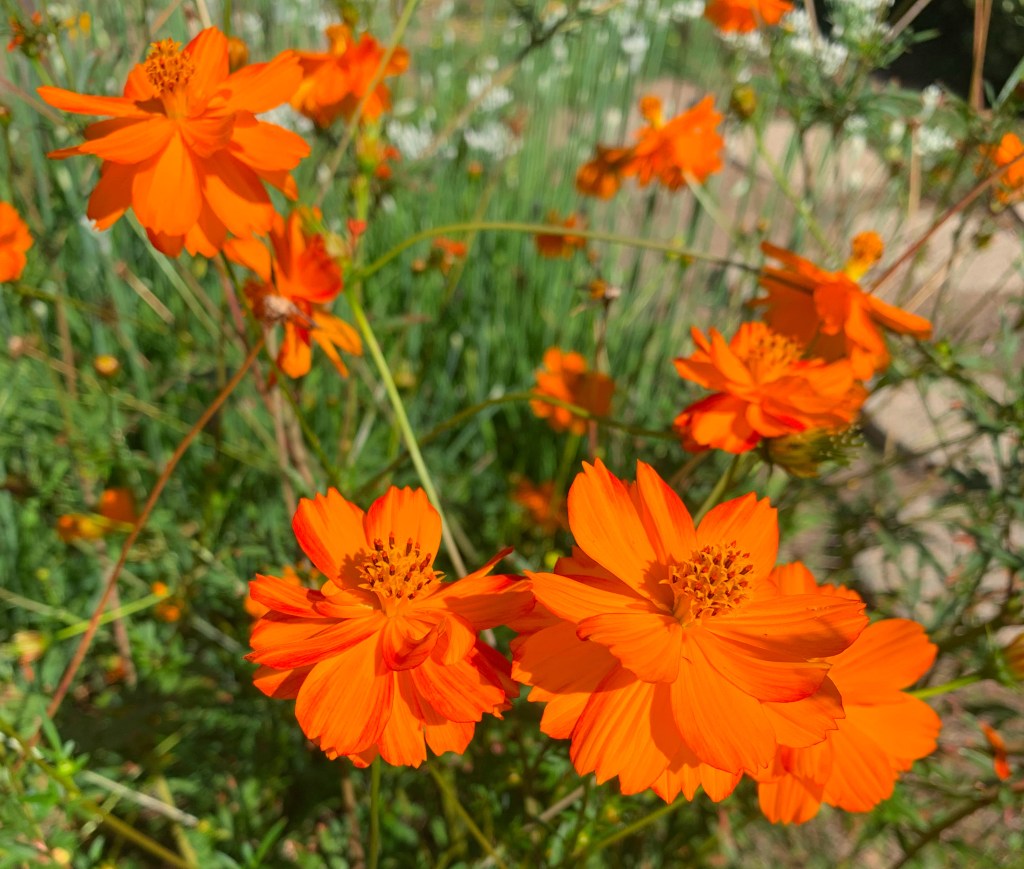
August is a full summer month with hot dry weather, except this year hurricane Hillary decided to head our direction. Before Hillary passed through we had temperatures well over 100 Fahrenheit (40 Celsius). The storm passed east of us but lowered the temperature significantly and dropped 3 inches or more (7-8 cm) of rain in one day. We had surprisingly little wind for a tropical storm.
The rain caused no problems in our local area. It was a nice refresher to the hot dry soil. Our lettuce really perked up after the rain. The rain was enough to get weed seeds germinating in open areas and even brought out attractive mushrooms (see our visitor log).
August gardening focused on harvesting all the summer produce and keeping plants from desiccating when temperatures are 104 F (40 C) with humidity below 10%.
A number of interesting visitors to the garden this month. We’ll give the birds a break this month and showcase a few insects, reptiles and fungi instead.
Contents of this Post
Here’s a summary of what’s in this post along with quick access links.
- Harvesting Now – What we’re harvesting and eating now
- Flowers and Herbs – Sweet potato flowers, marjoram, and the demise of a sunflower
- Coming Soon – Late summer okra and lettuce for September delivery?
- Visitor Log
- Hornworms, tobacco or tomato?
- Praying Mantis raptors of the insect world
- Bumblebee stealing nectar from morning glory
- Lizards on our pest management team
- Yellow Dapperling mushrooms make a surprise appearance
Harvesting Now
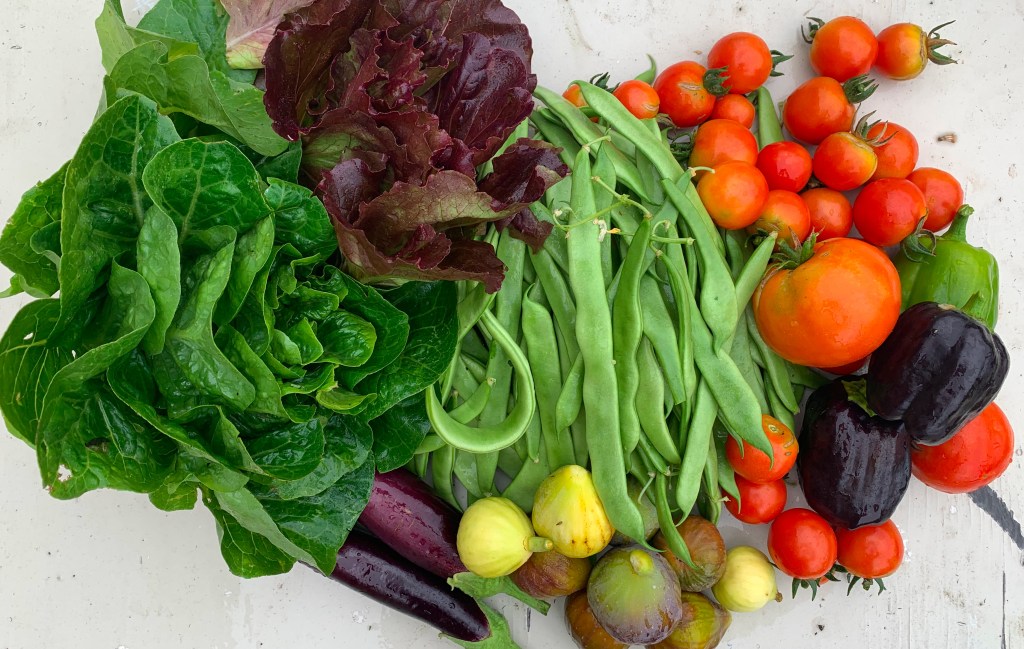
August is a big harvest month. Summer crops are in full swing with lots of green beans, squash, tomatoes, eggplants, figs, lettuce, basil and more!
In the photo above we have our favorite dark green Monte Carlo lettuce along with the red leaf Cherokee lettuce, Northeaster green beans with their wide flat pods, a variety of tomatoes, green and purple bell peppers, two varieties of figs, and Japanese eggplants.
Many crops are later than usual in getting ripe this year. The Indian fig, which looks similar to a Turkish brown fig, usually gets ripe in early August and finishes by September, but this year it’s a couple weeks late. The smaller round green figs, that look like a Genoa fig or white fig, hits its prime in September to give us nice late summer figs. They will probably go into October this year!
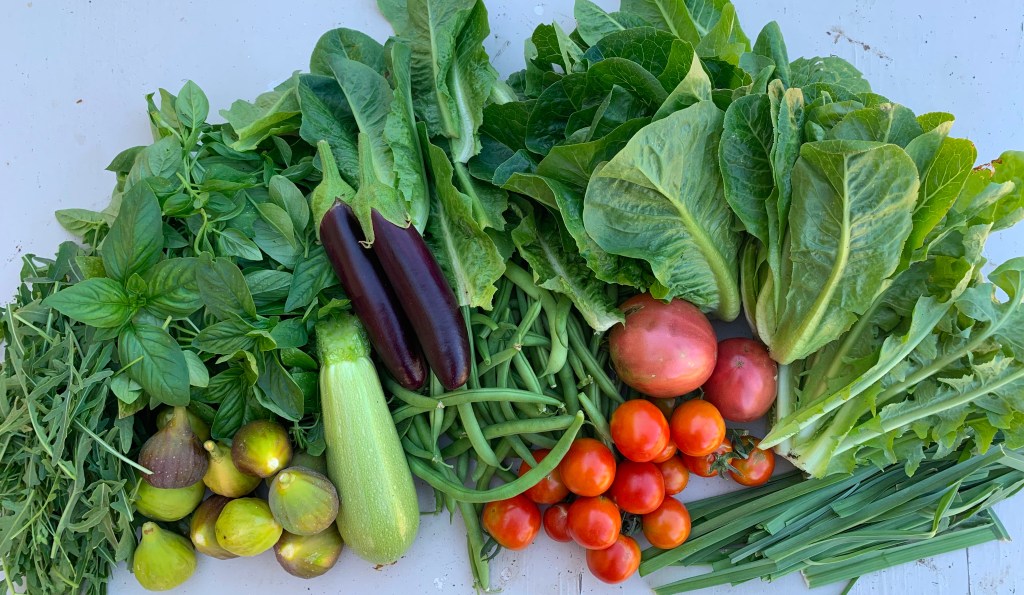
In this second photo we have wild arugula, basil, figs, squash, eggplant, green beans, tomatoes, lettuce, escarole and tareh (garden leeks) for a day’s harvest. Tareh has a nice leek flavor, but is smaller and more tender than the typical large leeks. They are nice eaten fresh like green onions, or used in cooking.
We usually harvest something everyday, rotating what is picked to get something fresh every day. Beans and squash are checked daily, figs every other day. Greens, like lettuce and escarole are less critical on timing so we pick them to meet our salad making desires.
The summer squash we are growing this year is the Dirani variety, a smooth light skinned squash. We have one plant that produces 5 to 7 pounds a week. Quite sufficient for our regular consumption. We started a second plant as a late season backup just in case.
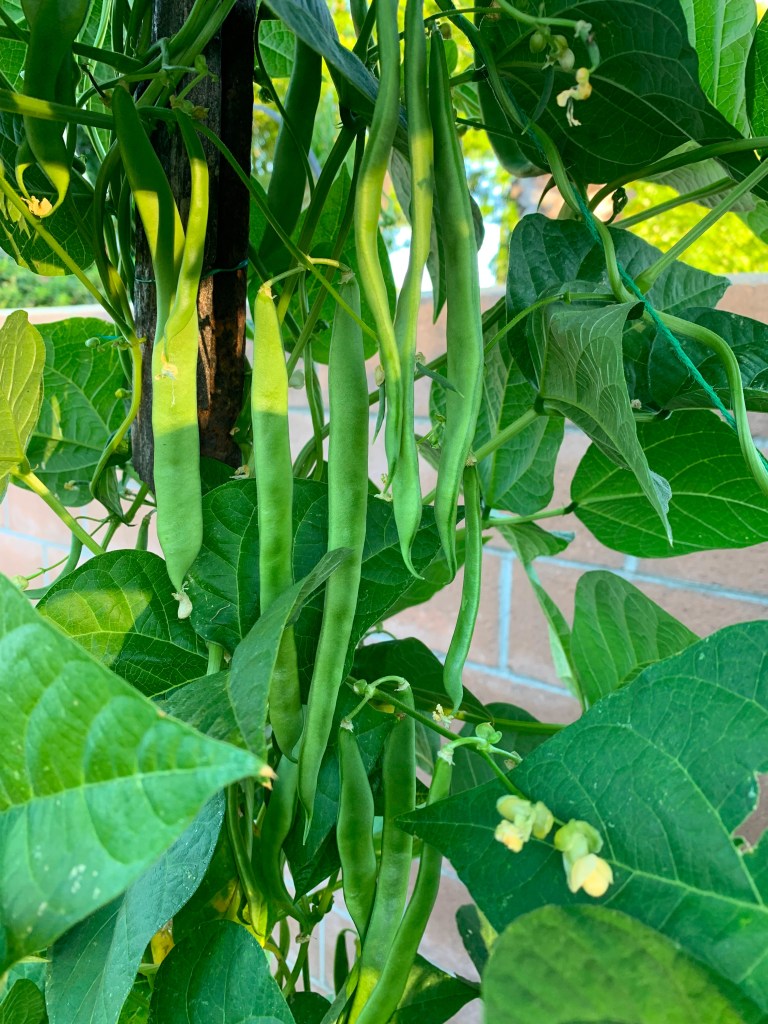
In the green bean category we are growing 4 different varieties. The Northeaster variety is a pole bean with a long wide flat Italian style bean. They have a nice mild flavor. We pick them when they are about 7 – 9 inches long (18 – 22 cm) and still tender.
Another Italian flat style bean is Dulcina, a bush bean. Dulcina was planted later and is just starting to produce. When the other beans are getting past their peak production the Dulcina should be picking up the slack.
We also have 2 standard bush bean varieties, Provider and Jade. We check the beans daily, as they mature quickly. Sometimes those beans hide from the harvester, so the daily checks help catch them before they go too large and tough.

The pole beans are one of those vining plants that are sensitive to touch. When the stems are growing they reach out and as they contact a pole, string, or another vine, they grow to twist themselves around the object. This characteristic helps them climb poles or other supports. Quite interesting to think how they adapted that sensitivity to touch.
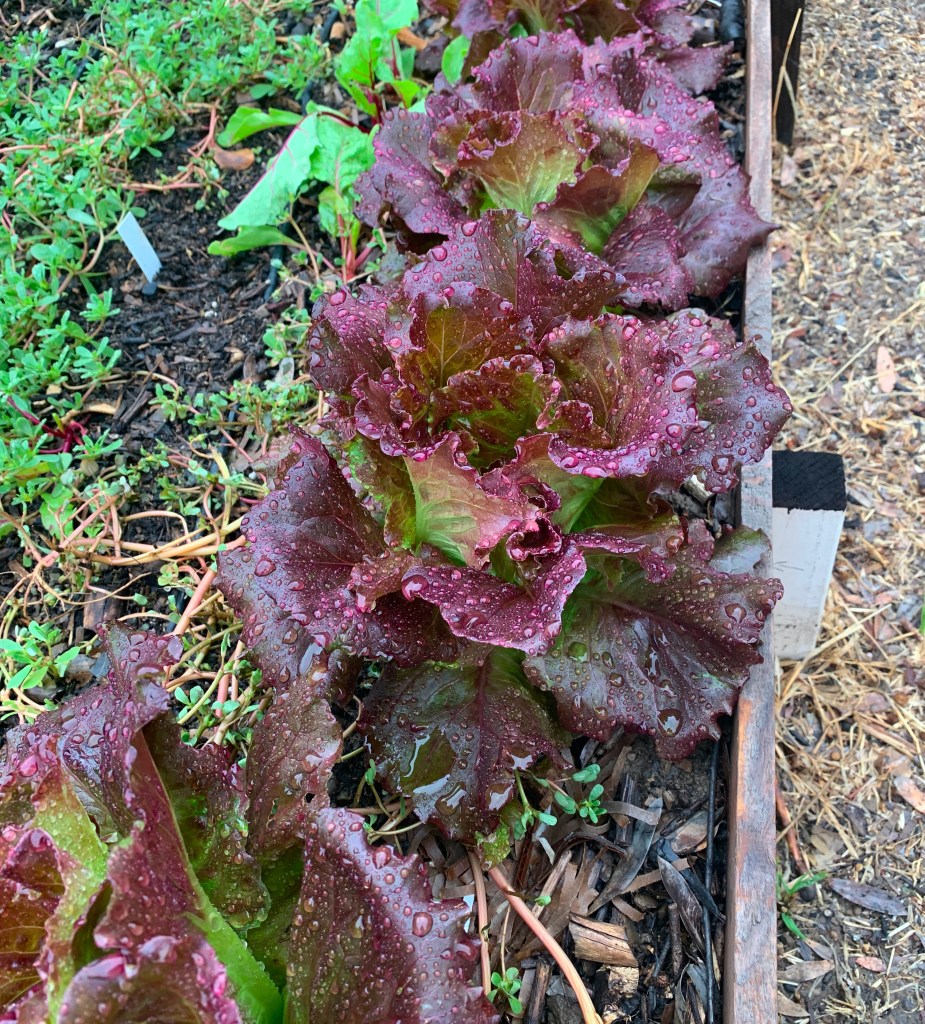
Lettuce managed to survive the heat of August. On days when the thermometer was around 104 Fahrenheit (40 Celsius) and humidity was close to 10%, the lettuce would start getting droopy. We have two main varieties the red leaf Cherokee, and the green romaine style Monte Carlo. An extra splash of water on those hot days was enough to keep them growing. Our bonus rain in August perked them up quite nicely so we had many tasty salads in August.
Flowers and Herbs
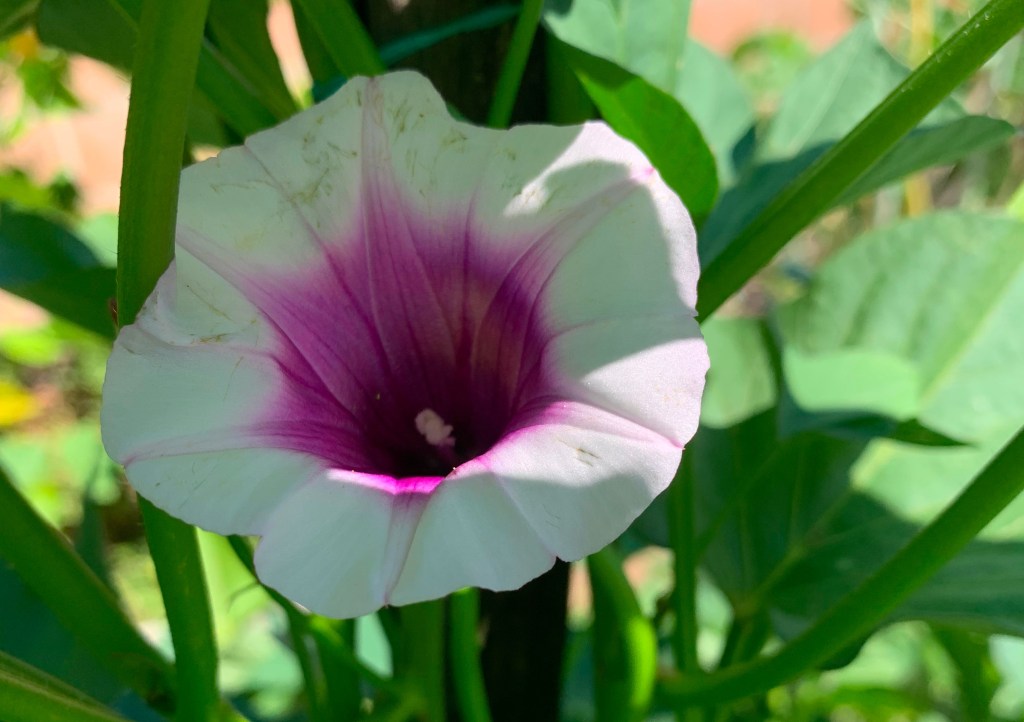
Sweet Potato Flowers
Sweet potatoes are vigorous vining plants with only an occasional flower. When flowers do appear, they look like a morning glory. No surprise as they are in the morning glory family, the Convolvulaceae. The purple-white flowers make an attractive contrast with the dark green sweet potato leaves.
Sweet potatoes have the same vining character of the morning glory. They would sprawl all over the garden if we allowed them. To get control over them we put stakes in the sweet potato bed and tie some of the longer vines to the stakes so they grow more vertically.
Marjoram Flowers
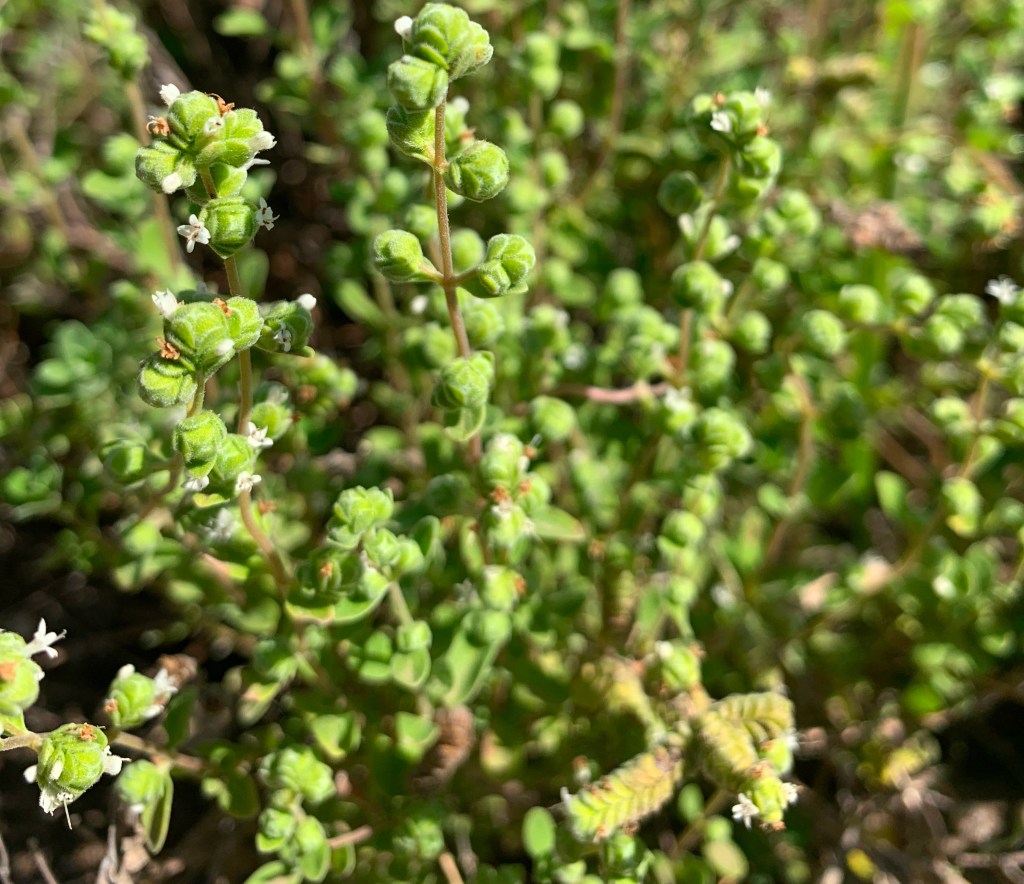
Marjoram is one of our favorite herbs. They have a delightful sweet flowery aroma and taste. A much more subtle aroma compared to their cousin, oregano. Marjoram leaves are much smaller than oregano, making it harder to get as large a quantity of leaves. Still well worth the effort. When we open that jar of dried marjoram while we are cooking the aroma is intoxicating.
Both marjoram and oregano have been in full bloom. The marjoram flowers are quite small but there are thousands of them. We will be trimming off the flowers and expect to get fall growth for one more harvest this season.
Sunflower Gets Decapitated
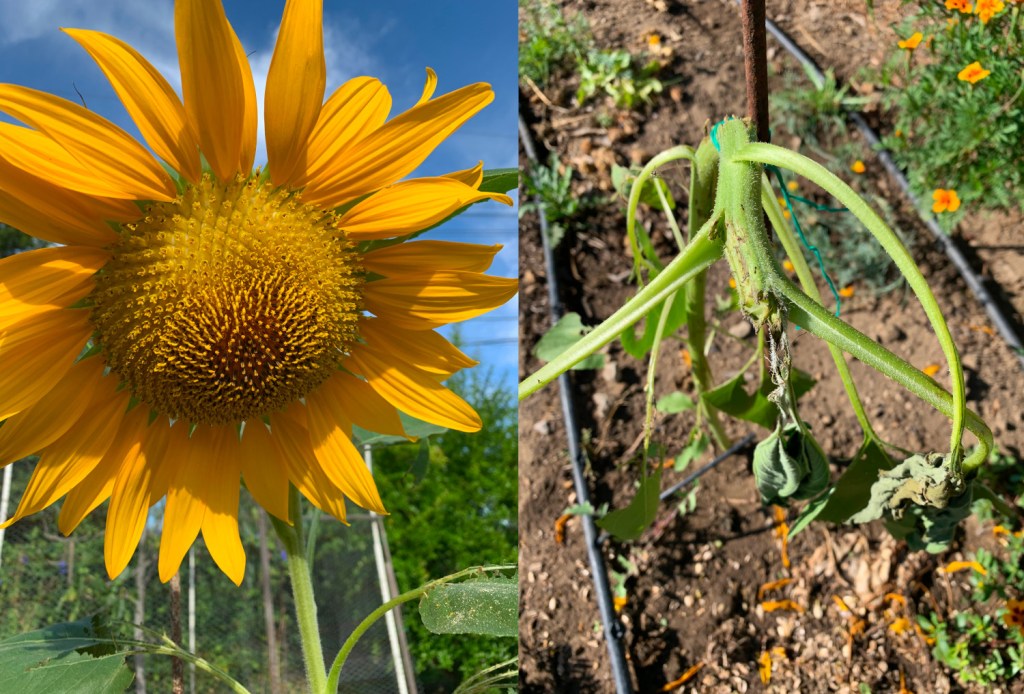
Sometimes our garden visitors act like vandals! Of course we understand they are looking for a good meal. Just seems they could leave a few bites for the gardeners! This large sunflower likely met its demise at the teeth of our local squirrel. As you can see, the whole head is gone, not just the seeds. Lots of sunflower seed shells on the ground as well. Another smaller sunflower that was not quite open yet met the same fate. The culprit did not even let the seeds get ripe. They looked nice for a while!
Coming Soon
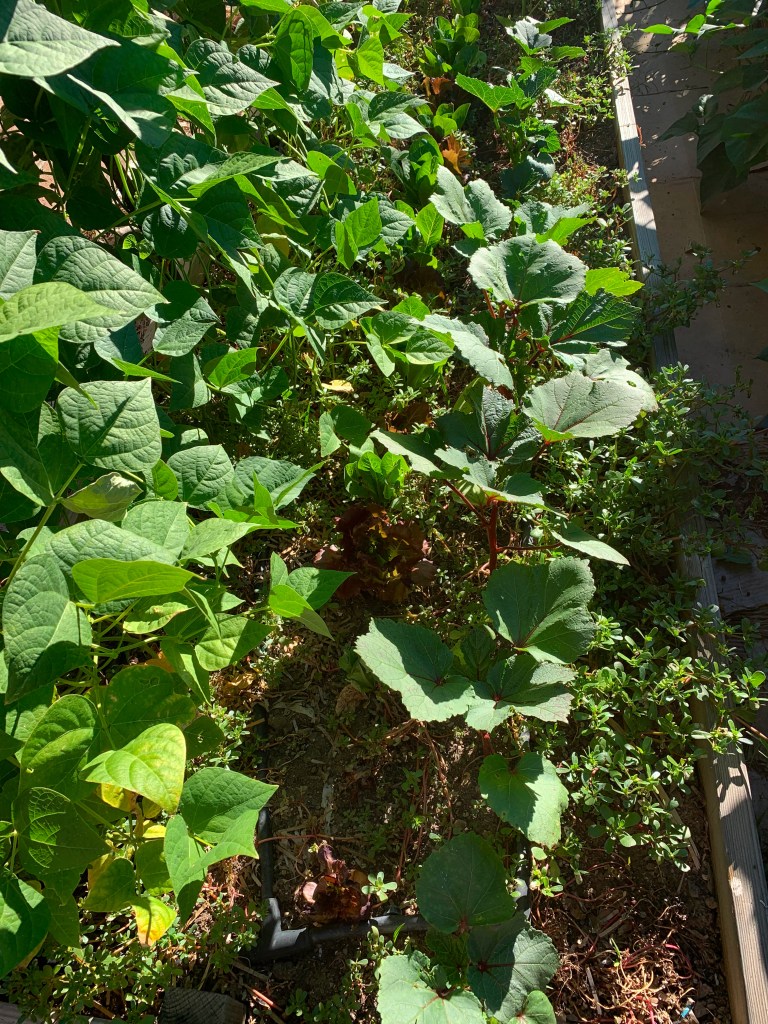
Okra was planted late to fill in the bed that had shallots. We planted in late July with hopes of harvesting in September. Okra plants are looking healthy and we see hints of flower buds coming, so should be soon. Okra fruits get ripe and ready to eat just a few days after flowering so once those flowers start opening we’ll be getting ready to harvest.
Behind the okra are the next planting of lettuce. Okra is starting to shade them, so hopefully they will still get enough sun to produce good lettuce. Lettuce grown in the shade tends to be thin and spindly. The pole beans behind the lettuce are doing great and tall enough to get plenty of sun!
Sweet potatoes are producing lots of thick vines and hopefully storing tasty carbohydrates in their thick roots. Typical harvest for them will be October and November.
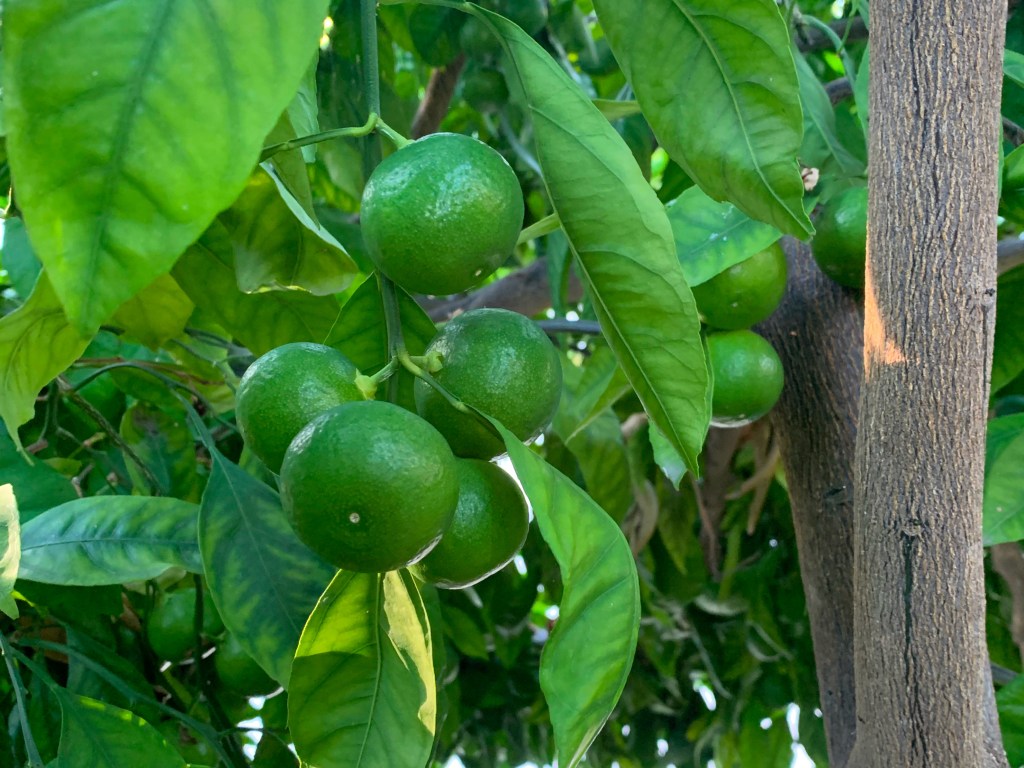
Citrus trees are starting to bend under their load of growing fruit. The Satsuma Mandarin gets clusters of fruit that look like bunches of grapes. Branches that started growing upwards are now bending low to the ground. Most years we harvest more than 100 pounds of mandarins, and this looks like a big harvest year. Harvest will usually start in the middle of November, so they will be getting bigger and heavier.
Visitor Log
Hornworms
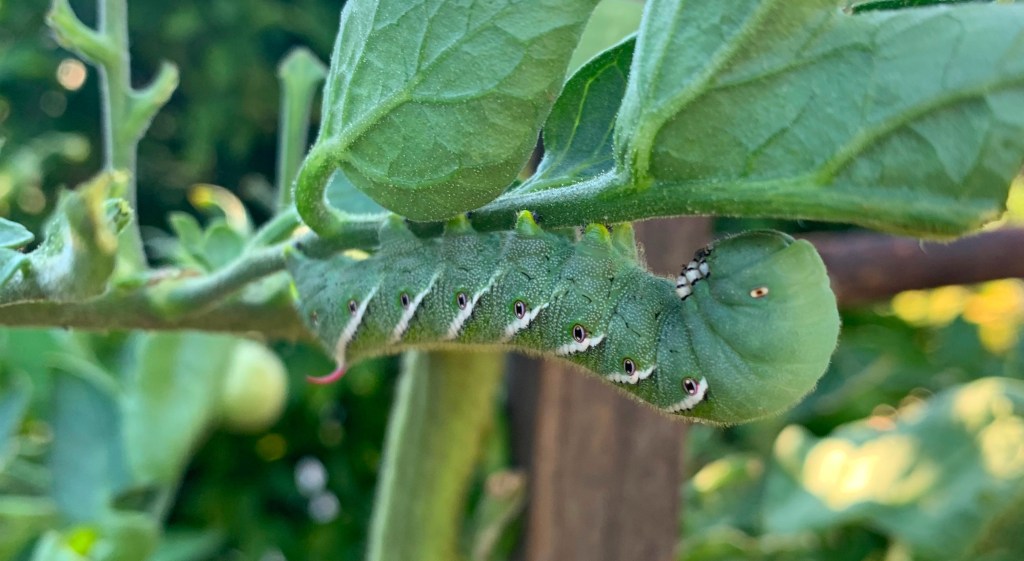
If you’ve grown tomatoes you’ve probably seen a visitor like this. Or if you didn’t see them, you at least saw leaves stripped bare from these large insects with equally large appetites.
There are 2 closely related hornworms. The tomato hornworm, Manduca quinquemaculata, and the tobacco hornworm, Manduca sexta. They look very similar and have similar diets, feeding on members of the Solanaceae, the nightshade or potato family. Tomatoes, eggplants, peppers, potatoes and tobacco are members of this family. Although they may eat other plants in the family, ours really favor the tomatoes.
The hornworm in our garden photo above is a tobacco hornworm. This species has a red horn and seven white diagonal lines, while the tomato hornworn has a dark blue or black horn and has 8 “V” shaped white markings.
The mature adult tomato hornworm is the five-spotted hawkmoth. These are large moths with wingspans up to 13 cm (5 inches). They have 5 yellow spots on each side of their abdomen, giving them their name. Their large size makes them very obvious, though they are most active at night.
Some interesting information about these moths is they are the primary pollinators of Datura, also known as jimsonweed. Datura is another member of the Solanaceae family that produces toxic compounds that have been used as poisons, but also have psychoactive properties. When hawkmoths visit Datura flowers, their flight becomes erratic and their landings are uncoordinated. Basically, they appear to get high on the nectar! But they come back for more.
Back to our garden hornworms, the larvae of these moths. They are quite good at hiding in the tomatoes. Their color and pattern blends in well with the tomato leaves. When we see leaves eaten down to the veins we start our search. It can take a close investigation to locate the culprit. Apparently a good way to spot them is to use a blacklight (UV) at night and the hornworms glow in the dark. Would be interesting to try.
Praying Mantis
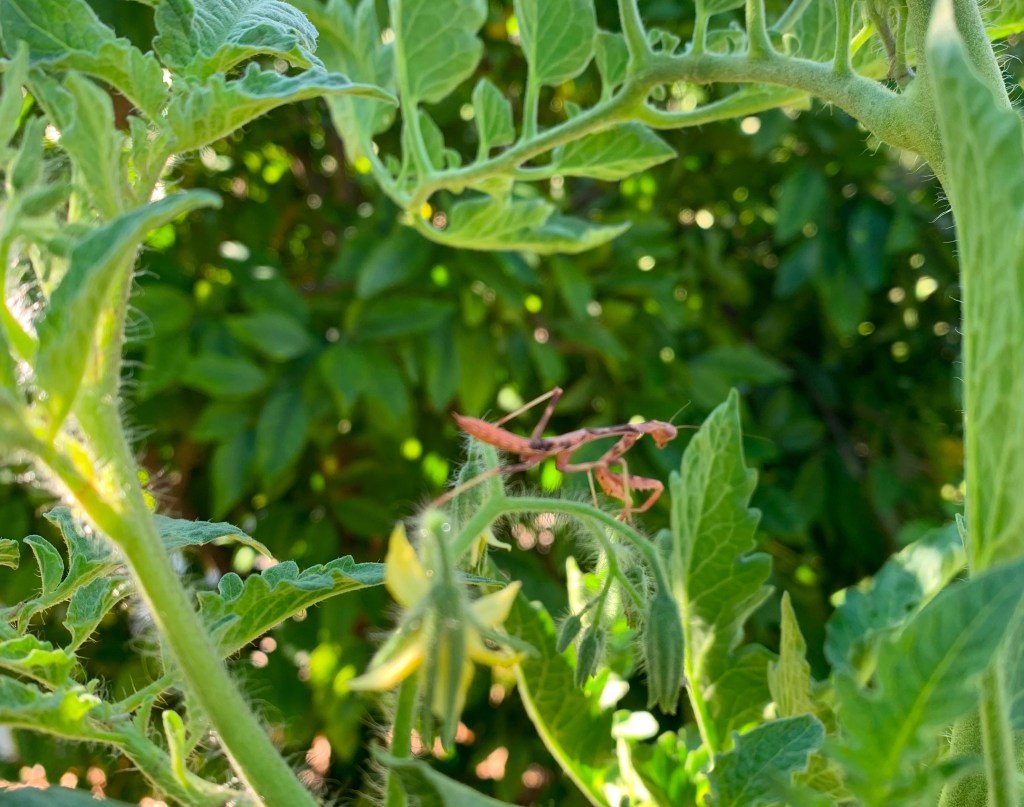
A praying mantis is one of our garden predators. They patiently wait in their “praying” position until an unsuspecting small creature comes within their reach. They feed on other insects. Large mantises will even eat small vertebrates like young lizards, frogs and birds.
They are well adapted for hunting with good stereo vision for depth perception, a head that can turn 180 degrees independent of the body, and long grasping raptor-like front legs. They often are well camouflaged and can change colors to match their background.
This one on our tomato plant appears to be quite a young small mantis and not well camouflaged at all. Maybe it’s looking for one of those fat juicy hornworms. That would be a least a weeks worth of meals for a mantis!
Bumblebee and Morning Glory
In addition to regular honeybees, we have some large black bumblebees visiting the garden frequently. We have seen them visiting morning glory flowers, but they are too big to get into the flowers and reach the nectar. They found a way around this obstacle. Very interesting to think how these bees know exactly where to find the nectar and how to get to it.
Lizard
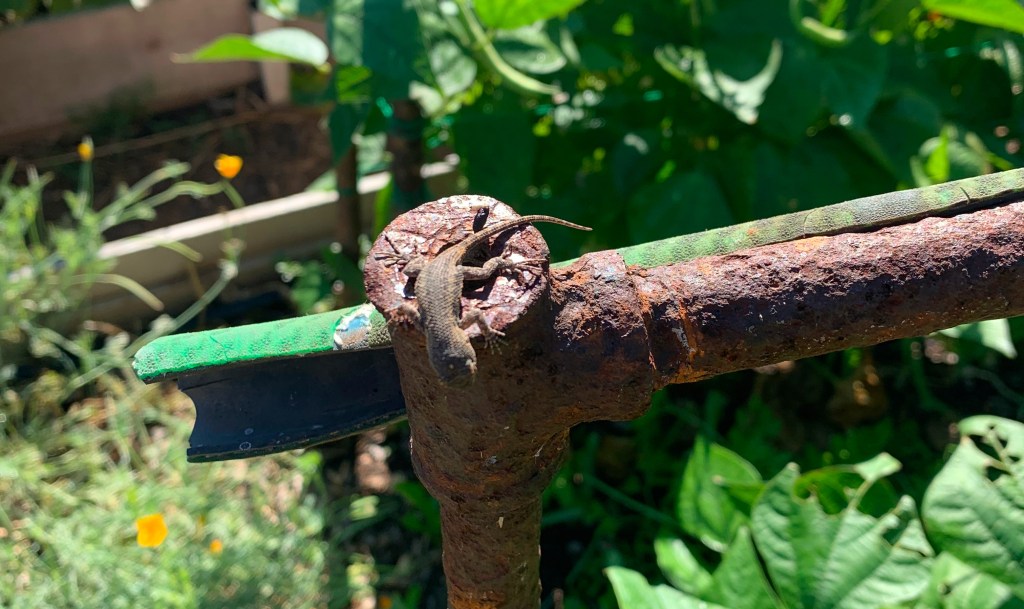
Lizards are another common predator in our garden. Right now we are seeing small young ones that have just hatched this summer. We have quite a few crickets around and are likely a great snack for the lizards. The lizards help control pests in our organic garden.
We have two or three varieties of lizards. They are a bit camera shy so don’t have good photos of them yet. We’ll have to make them the subject of a future photo or video project.
Mushrooms
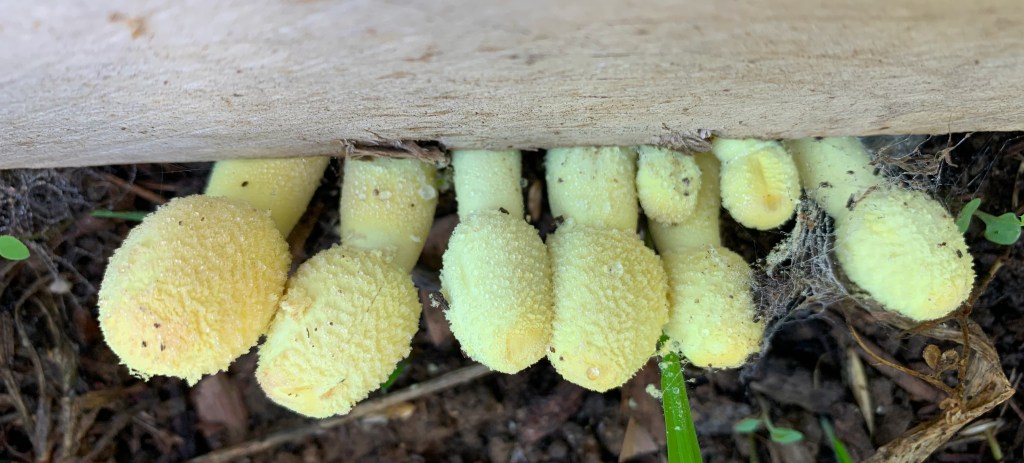
We found this attractive cluster of mushrooms popping out from the bottom of one of our raised beds. They appear to be Leucocoprinus birnbaumii, with the common name of plantpot dapperling, or flowerpot parasol.
They are a tropical to subtropical mushroom also frequently found in temperate climates associated with greenhouses and flowerpots, which gives them their plantpot or flowerpot names. The “dapperling” comes from their “dapper” or stylish looks. These young mushrooms opened up and formed the traditional parasol shaped mushroom a day after this photo.
Their color is described by some as lemon yellow or sulfur colored. Ours appear to be more of a lemon cream color. But don’t even think of eating them, they are considered moderately toxic.
These mushrooms appeared a couple weeks after tropical storm Hillary passed through and gave us a rare summer rainstorm. That moisture probably triggered their growth. Like most fungi, these mushrooms spend most of their life growing underground or on decaying material as masses of threadlike mycelia.
Mushrooms grow out of these mycelia in a short lived growth spurt to produce spores then the mushroom soon fades away. They need just the right environment of temperature and moisture to produce mushrooms. A burst of moisture and warm summer weather probably had these tropical mushrooms thinking of their ancestral homeland!
Find Peace in a Garden
Find time to get out in a garden, a park or a spot where nature is on display. Listen to the sounds of those birds, observe the colors and amazing details in all flowers and plants, find peace.
If there are topics you would like to hear more about, let us know in the comments below, or send an email to Zanganeh.Garden@gmail.com.
We post quick updates on Instagram @Zanganeh.Garden
Check out our YouTube channel, also @Zanganeh.Garden
Use the subscribe button below to be notified of new posts.
 Zanganeh Garden